

Indonesia’s Wildfire Haze Reaches the Philippines—and Exposes a Much Bigger Air-Pollution Problem
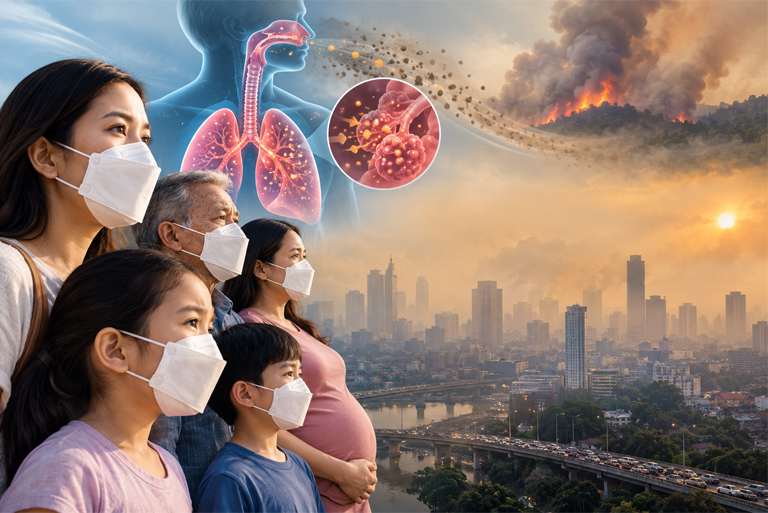
How do we protect our lungs and hearts when the air itself becomes hazardous?
You cannot always see the most dangerous part of polluted air. PM2.5—particles measuring 2.5 micrometers or less—can penetrate deep into the lungs, and some particle components can enter the circulation. As smoke and haze from fires in Kalimantan, Indonesia, are carried toward parts of the Philippines, Metro Manila has recorded seriously degraded air quality. For people with asthma, COPD and cardiovascular disease—and for children, older adults and pregnant women—the danger deserves particular attention. But the episode also exposes a larger problem: Filipinos breathe pollution from traffic, combustion and other sources even when there is no foreign wildfire. What should families do today, and what must the country do for cleaner air tomorrow?
“We can choose our food, our water and whether to smoke. But we cannot choose not to breathe. That is why clean air must be treated as a public-health necessity, not a luxury.”
By Rafael R. Castillo, MD
Something Was Different About the Sky
Imagine stepping outside one morning in Metro Manila.
The sun is visible, but strangely muted. The skyline seems blurred. The familiar buildings in the distance appear behind a gray veil.
Perhaps your eyes begin to sting. Your throat feels scratchy.
Someone with asthma reaches for an inhaler. And the question spreads through family chats and social media:
What is happening to our air?
This time, the answer appears to stretch hundreds of kilometers beyond Philippine shores.
On September 1, DENR-EMB said elevated PM2.5 in Metro Manila may be associated with smoke and haze from ongoing fires in Kalimantan, Indonesia, transported toward the Philippines by prevailing Habagat winds. The DOH separately reported haze reaching parts of Luzon and the Visayas and advised people to reduce unnecessary outdoor exposure and wear N95 respirators when appropriate.
It is an extraordinary reminder of a basic atmospheric truth:
Air pollution does not carry a passport.
Smoke released in one country can become a health problem in another.
What Exactly Are We Breathing?
Wildfire smoke is not a single substance.
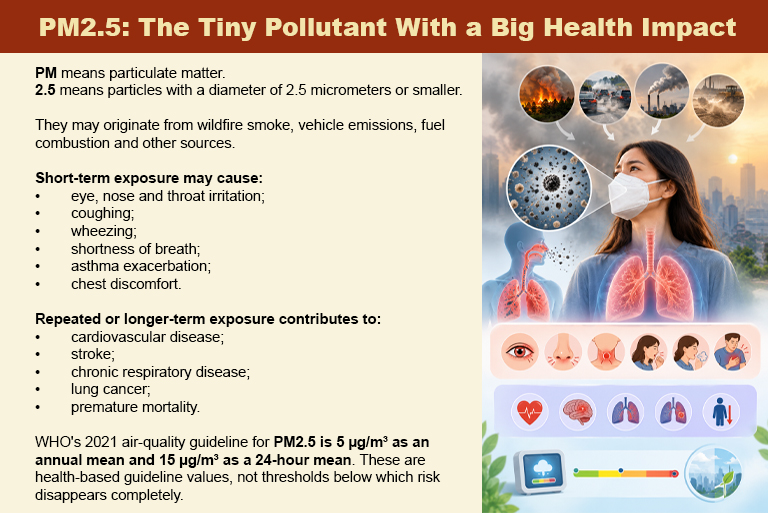
It is a complex mixture of gases, vapors and particulate matter generated when vegetation and other materials burn. From a health perspective, one of its most important components is PM2.5.
The name refers to particles with an aerodynamic diameter of 2.5 micrometers or smaller. For perspective, they are roughly 1/30 the diameter of a human hair. Their microscopic size is precisely what makes them troublesome.
Larger particles tend to be trapped in the nose and upper airways. Fine particles can travel much deeper into the respiratory tract, reaching the alveolar regions where oxygen exchange occurs.
Exposure can provoke airway irritation and inflammation and worsen existing respiratory disease. Wildfire smoke can cause coughing, wheezing, difficulty breathing, asthma attacks, irritated eyes and throat, headache, fatigue, chest pain and a rapid heartbeat.
But this is not merely a lung story.
From the Lungs to the Heart
One of the great advances in environmental medicine has been recognizing that air pollution is also a cardiovascular risk factor. Fine-particle exposure can trigger systemic inflammation, oxidative stress, autonomic nervous-system disturbances, endothelial dysfunction and changes favoring thrombosis.
For susceptible individuals, polluted-air episodes have been associated with increased cardiovascular events. This means the patient we worry about during severe air pollution is not merely the child with asthma.
It may also be the grandfather with coronary artery disease. The grandmother with heart failure. The hypertensive patient. The stroke survivor. Or the seemingly stable person whose underlying cardiovascular vulnerability has not yet announced itself.
WHO now regards air pollution as one of the world’s major environmental health risks, with a disease burden comparable in scale to other major global risks.
“PM2.5 is small enough to be invisible to us, but its health consequences can reach from the deepest parts of the lungs to the cardiovascular system.”
Who Should Be Most Careful?
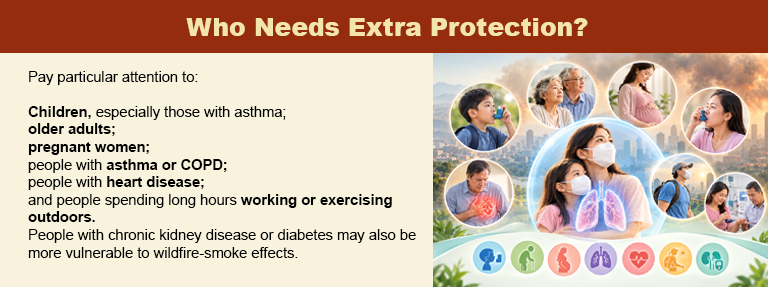
Wildfire smoke can affect anyone, particularly when concentrations become high.
Some people, however, have greater vulnerability.
These include those with asthma, COPD, heart disease and other chronic conditions; children; pregnant women; and people whose jobs require prolonged outdoor exposure.
Older adults frequently have underlying cardiovascular or respiratory disease.
Children breathe more air relative to their body size and their lungs are still developing. Children with asthma deserve particular vigilance. CDC recommends keeping children indoors as much as possible when air quality is poor and reducing smoke exposure promptly if respiratory symptoms develop.
Outdoor workers present a special Philippine challenge. Traffic enforcers, delivery riders, construction workers, street vendors and security personnel cannot simply remain indoors whenever pollution rises.
Protecting them therefore becomes an occupational-health responsibility as well as an individual one.
Should Everyone Stop Exercising?
Exercise is medicine. But dose and environment matter.
When particulate pollution becomes severe, vigorous outdoor exercise increases the amount of polluted air inhaled because we breathe faster and more deeply.
So this is not the day for an outdoor long run simply because “exercise is healthy.”
Move the workout indoors to a cleaner-air environment or postpone strenuous outdoor activity until air quality improves.
Athletic training, school PE classes and outdoor sports should likewise take current air-quality conditions into account.
The goal is not to become sedentary. It is to avoid converting an otherwise healthy activity into unnecessary pollutant exposure.
Does an N95 Really Help?
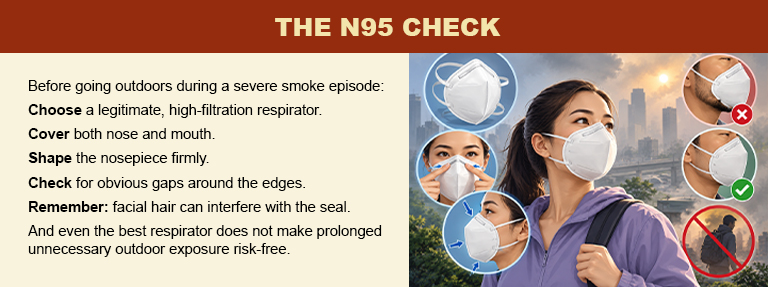
Yes—if it fits and is worn correctly.
A well-fitting N95 or similar particulate respirator can substantially reduce inhalation of fine particles. It works best when it seals closely around the face. Gaps markedly reduce protection.
A loose surgical mask is not equivalent protection against wildfire PM2.5.
Neither are cloth masks, bandanas or wet handkerchiefs.
CDC notes that properly fitted NIOSH-approved N95 or P100 respirators can filter smoke and PM2.5 particles, although they do not protect against all gases and vapors present in smoke.
People with significant heart or lung disease who find respirators difficult to tolerate should discuss their individual situation with their physician.
Is Staying Indoors Enough?
Usually it substantially reduces exposure—but only if indoor air remains cleaner.
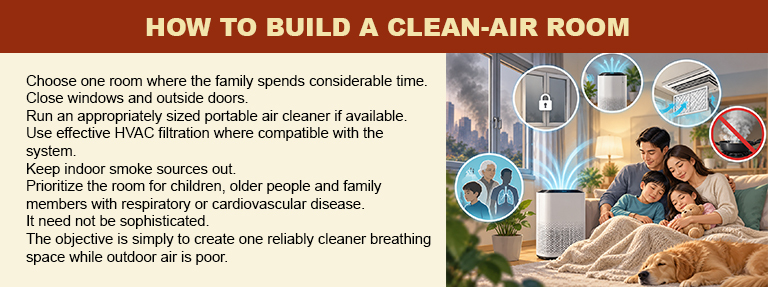
Close windows and doors during severe outdoor smoke episodes. If air conditioning is available, use a recirculation mode where appropriate rather than continually drawing smoky outdoor air inside.
Portable air cleaners equipped with appropriate particle filtration can reduce indoor PM concentrations.
Consider creating a clean-air room—one room where windows and doors remain closed and filtration is concentrated.
But there is an easily overlooked problem.
People can pollute indoor air themselves.
During a smoke event, avoid adding unnecessary particles through:
- cigarette smoking or vaping;
- burning candles or incense;
- wood or charcoal burning;
- aerosol sprays;
- frying or broiling that produces substantial smoke;
- activities that resuspend settled particles.
CDC specifically recommends minimizing indoor particle-generating activities when trying to maintain cleaner indoor air.
When Should Symptoms Worry Us?
Mild eye irritation or scratchy throat may improve when exposure stops.
But certain symptoms deserve prompt attention:
- significant shortness of breath;
- persistent or severe wheezing;
- an asthma attack not responding adequately to the usual action plan;
- chest pain or pressure;
- fainting or marked dizziness;
- confusion;
- bluish discoloration;
- severe respiratory distress.
Patients with established asthma should follow their physician-prescribed asthma action plan and keep rescue medication accessible.
Patients with heart disease should not automatically attribute chest discomfort to “the haze.”
Chest pain remains chest pain until properly evaluated.
The Bigger Story: Indonesia Is Not Our Only Problem
It would be convenient to blame today’s polluted sky entirely on another country. That would also miss the larger public-health lesson.
Transboundary wildfire smoke can cause dramatic pollution spikes, but Metro Manila has important domestic pollution sources of its own.
Motor vehicles. Combustion. Industry. Construction dust. Waste burning. Other urban emissions.
The current episode therefore acts like a stress test. It exposes how vulnerable a densely populated metropolis already carrying a background pollution burden can become when an additional plume arrives from abroad.
And because the atmosphere is dynamic, today’s “acutely unhealthy” monitoring station may improve later while another worsens.
This is why people should check real-time DENR-EMB monitoring rather than relying indefinitely on screenshots circulated on social media.
Climate Change and the Wildfire Connection
One must be careful here.
It would be scientifically simplistic to declare that climate change “caused” a particular Indonesian wildfire without event-specific attribution analysis. But the broader relationship between climate, heat, drought, vegetation dryness and wildfire risk is well established in many regions.
That matters to the Philippines because climate-related health threats increasingly ignore borders.
We may not have started the fire. We can still inhale its smoke.
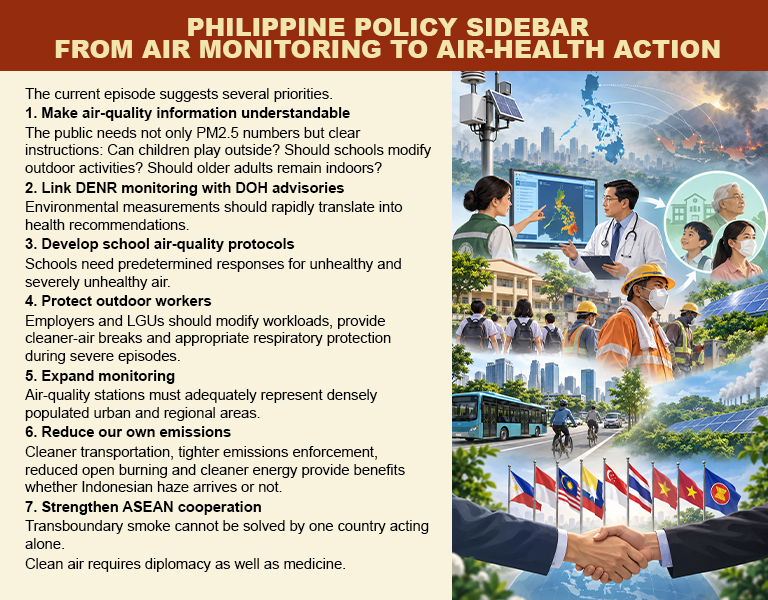
Transboundary haze therefore requires regional cooperation in fire prevention, land management, environmental monitoring and rapid information exchange.
ASEAN environmental policy becomes, quite literally, health policy.
REFERENCES
- World Health Organization. WHO Global Air Quality Guidelines: Particulate Matter (PM2.5 and PM10), Ozone, Nitrogen Dioxide, Sulfur Dioxide and Carbon Monoxide. Geneva: WHO; 2021.
- World Health Organization. WHO Global Air Quality Guidelines: Questions and Answers. Geneva: WHO; September 22, 2021.
- Department of Environment and Natural Resources–Environmental Management Bureau, National Capital Region. Air Quality Data: Real-Time Ambient Air Quality Monitoring. DENR-EMB NCR; accessed September 1, 2026.
- Philippine News Agency. DOH urges face masks, limited outdoor activities amid Indonesia haze. September 1, 2026.
- GMA News Online. ‘Acutely unhealthy’ air quality level in several NCR areas amid haze from Indonesia. September 1, 2026.
- Centers for Disease Control and Prevention, National Institute for Occupational Safety and Health. How to Protect Workers and the Public from Wildfire Smoke. Atlanta: CDC/NIOSH; 2025.
- Centers for Disease Control and Prevention. How Wildfire Smoke Affects Your Body. Atlanta: CDC.
- Centers for Disease Control and Prevention. Wildfire Smoke and Children. Atlanta: CDC.
- Philippine Atmospheric, Geophysical and Astronomical Services Administration. Start of the Southwest Monsoon. Quezon City: DOST-PAGASA; 2026.
FAMILY ACTION PLAN
What To Do When the AQI Turns Bad
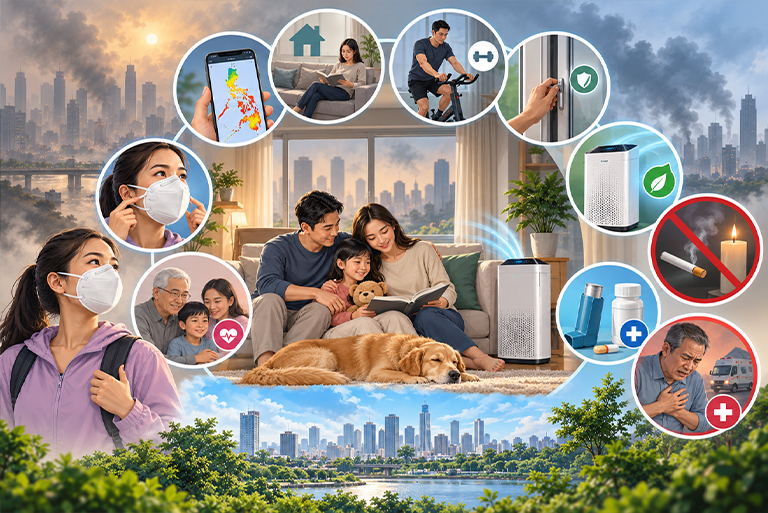
Check: Look at current official air-quality information rather than yesterday’s screenshot.
Stay in: Reduce unnecessary outdoor exposure when pollution is severe.
Move exercise indoors: Especially strenuous activity.
Close up: Keep smoky outdoor air from entering as much as practicable.
Filter: Use suitable air filtration where available.
Mask properly: Use a well-fitting N95 or comparable particulate respirator when outdoor exposure is unavoidable.
Protect the vulnerable: Check children, older relatives and people with asthma, COPD or cardiovascular disease.
Keep medicines ready: Especially inhalers and prescribed cardiovascular medications.
Don’t add smoke indoors: No smoking, candles or unnecessary combustion.
Know the red flags: Breathing difficulty and chest pain deserve medical attention.
A Crisis We Can Actually Breathe In
Environmental crises often feel remote. Deforestation happens somewhere else. Global warming is measured in fractions of degrees. International environmental agreements are negotiated in conference halls most people will never enter.
Air pollution is different. We breathe it.
Approximately 20,000 times a day, an adult inhales and exhales. Breathing is so automatic that we notice it mainly when it becomes difficult.
That is what makes today’s haze more than an unusual weather event. It is a warning.
The atmosphere connects Manila to Kalimantan and every community in between. What burns hundreds of kilometers away can eventually reach a Filipino child’s lungs. But the lesson should not end when the haze clears.
Because the smoke from Indonesia will eventually disperse. Metro Manila’s traffic will remain. Its combustion emissions will remain. Its vulnerable children, elderly people and patients with heart and lung disease will remain.
Perhaps the clearest air-quality message is therefore not simply:
Protect yourself from this week’s haze.
It is:
Demand healthier air every week of the year.
“The Indonesian haze will eventually pass. Our responsibility to make Philippine air safer must not pass with it.”







Leave a Reply