

Syncope: Why We Faint, When It Is Dangerous, and What Could Save a Life

By Rafael R. Castillo, MD
One moment you are standing, walking, praying in church, exercising—or simply getting out of bed. The next, you are on the floor.
Syncope, commonly called fainting, is a sudden, brief loss of consciousness caused by a temporary reduction in blood flow to the brain, followed by spontaneous recovery. Often, the explanation is relatively benign: prolonged standing, emotional stress, pain, dehydration, or a sudden fall in blood pressure. But sometimes fainting is the first warning of an abnormal heart rhythm, severe structural heart disease, internal bleeding, pulmonary embolism, or another serious disorder.
The challenge is not simply deciding whether someone fainted. It is determining why.
Because while most faints are not fatal, the faint that must never be dismissed is the one caused by a dangerous underlying disease.
“Syncope is not a diagnosis. It is a symptom. The important question is not simply, ‘Why did you fall?’ but ‘Why did your brain temporarily lose enough blood flow to switch consciousness off?’”
A Few Seconds That Can Change Everything
Imagine a 72-year-old man attending a family gathering. He feels perfectly well. While walking across the room, he suddenly collapses. There is no warning. Within seconds he awakens, confused about why everyone is standing around him.
“Okay lang ako,” he insists.
Someone suggests that he was hungry. Another says it must have been the heat.
Perhaps.
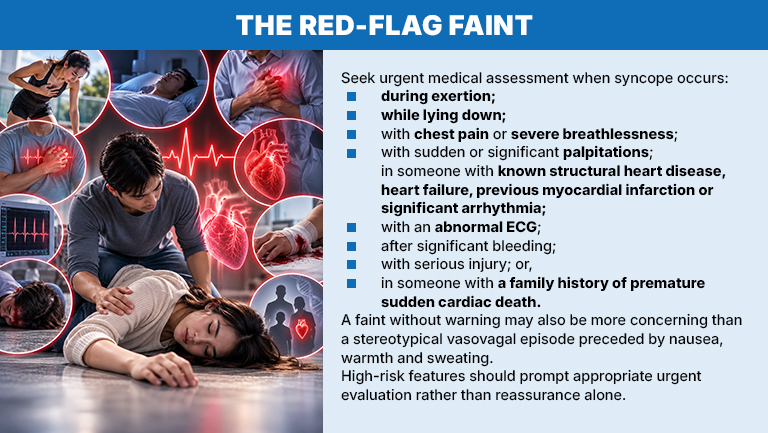
But suppose he has coronary disease. Suppose his pulse was extraordinarily slow immediately after the event. Suppose the collapse occurred during exertion. Suppose his brother died suddenly at age 48.
Those details transform an apparently simple faint into something considerably more concerning.
The central lesson of syncope is therefore:
The story surrounding the faint may be more important than the faint itself.
What Exactly Is Syncope?
Syncope is an abrupt, transient, complete loss of consciousness accompanied by loss of postural tone, followed by rapid and spontaneous recovery. The underlying mechanism is temporary global cerebral hypoperfusion—briefly, the brain does not receive sufficient blood flow.
That definition is important because not every blackout is syncope.
Seizures can cause loss of consciousness. Hypoglycemia can alter consciousness. Intoxication can do so. Head trauma can. Some psychological conditions can mimic transient loss of consciousness.
A stroke rarely presents as an uncomplicated brief faint with complete rapid recovery. So when someone says, “I blacked out,” the physician begins detective work.
THE THREE BIG FAMILIES OF SYNCOPE
For practical purposes, most true syncope can be understood through three broad mechanisms.
1. Reflex—or Vasovagal—Syncope
This is the classic faint.
A trigger—pain, fear, emotional distress, prolonged standing, heat, seeing blood—provokes an inappropriate reflex that lowers blood pressure, sometimes slows the heart rate, and temporarily reduces cerebral perfusion.
The patient may first experience:
· nausea;
· warmth;
· sweating;
· pallor;
· lightheadedness;
· blurred or tunnel vision; or,
· the feeling that “everything is going dark.”
Then consciousness is lost. Once horizontal, blood flow to the brain improves, and recovery usually follows.
This type is generally benign in terms of mortality, although the fall itself can cause serious injury.
2. Orthostatic Hypotension
You are lying down. You stand. Gravity suddenly shifts blood toward the legs and abdomen.
Normally the cardiovascular and autonomic systems compensate immediately. But if compensation is inadequate, blood pressure drops excessively and cerebral perfusion may fall.
Older adults are particularly susceptible. Why?
Aging can impair autonomic reflexes. Dehydration reduces circulating volume. And many older people take multiple medications that lower blood pressure.
Common contributors include:
· diuretics;
· vasodilators;
· some antihypertensive drugs;
· certain antidepressants and psychotropic medications;
· dehydration;
· blood loss;
· autonomic disorders; and,
· prolonged bed rest.
This is why measuring blood pressure lying and standing is not an old-fashioned ritual. It is a fundamental part of syncope evaluation. ESC guidance specifically includes standing BP in the initial assessment.
3. Cardiac Syncope: The One We Fear Most
Here the heart itself may be responsible. A dangerously slow rhythm can suddenly reduce cardiac output. So can a very rapid tachyarrhythmia.
Structural disease may interfere with the heart’s ability to maintain circulation, particularly during exertion.
Possible causes include significant bradyarrhythmias, ventricular tachyarrhythmias, severe aortic stenosis, hypertrophic cardiomyopathy and other important cardiac disorders.
The event may be abrupt—with little or no warning. And unlike ordinary vasovagal syncope, the underlying condition may carry a risk of sudden cardiac death.
“A faint during emotional stress may be innocent. A sudden collapse during exertion or while lying down—particularly in someone with heart disease—demands much greater respect.”
The Elderly Patient Deserves Special Attention
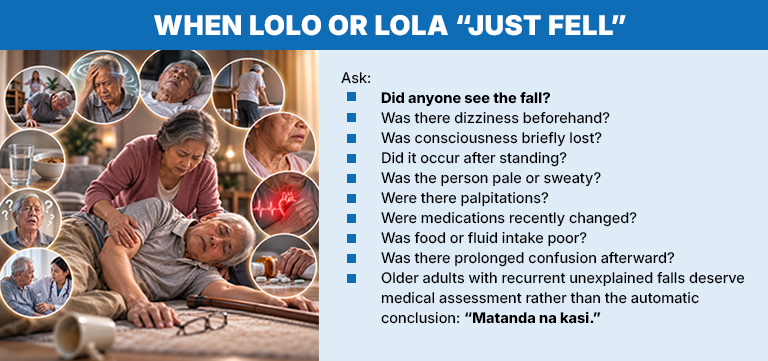
Syncope becomes particularly consequential in older people. An elderly person may not remember losing consciousness. He may simply say: “I fell.”
That can lead families to attribute the event to poor balance or aging. But unexplained falls and syncope can overlap in older adults.
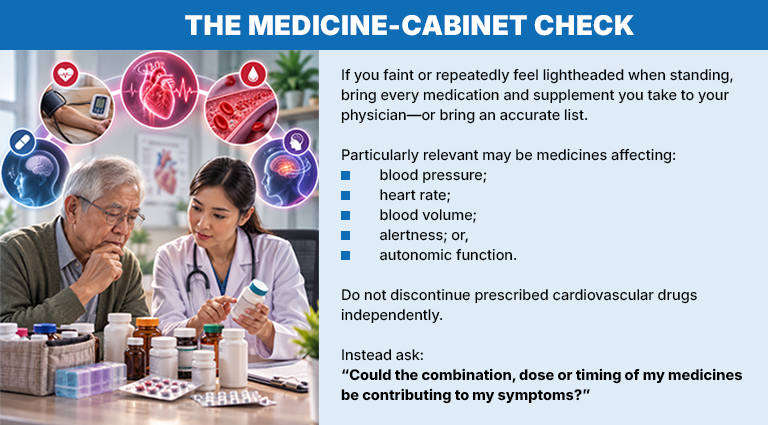
Polypharmacy further complicates matters. A patient may be taking an antihypertensive, diuretic, nitrate, alpha-blocker, sedative or other medications that contribute to hypotension or impaired compensatory responses.
Then there is injury. A 25-year-old may faint and acquire a bruise. An 85-year-old with osteoporosis may sustain a hip fracture, intracranial injury or loss of independence.
Thus, the consequence of syncope is determined not only by why the person fainted, but also by where and how the person landed.
Syncope or Seizure?
This is one of the common diagnostic dilemmas. Both can involve sudden collapse and loss of consciousness. Brief jerking movements can even occur during syncope, so jerking does not automatically mean epilepsy.
The physician therefore asks about the entire episode.
What happened before?
What did witnesses see?
How long was consciousness lost?
What happened afterward?
A prolonged post-event period of confusion may favor seizure, while typical syncope generally has relatively rapid spontaneous recovery.
Tongue injury, stereotyped seizure activity and other historical clues may help—but no single sign should replace proper assessment.
ESC guidance emphasizes history from both patient and eyewitness because careful clinical history alone can distinguish many forms of transient loss of consciousness.
Smartphone medicine
If recurrent episodes occur and it can be done safely, a witness’s smartphone recording can sometimes provide clinicians with valuable information about what actually happens during an attack. But do not delay first aid to make a video.
What Should You Do When Someone Faints?
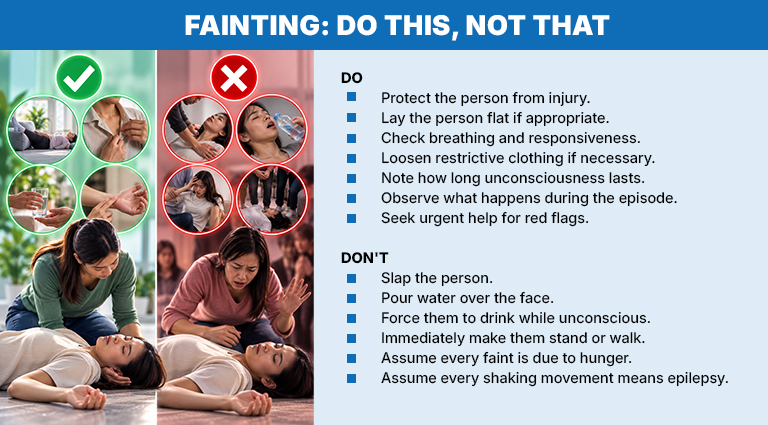
The first priority is safety. If the person collapses, prevent further injury if possible. Check responsiveness and breathing.
If the person is not breathing normally, activate emergency medical services and begin CPR according to current resuscitation guidance.
If breathing normally and a simple faint seems likely, place the person flat, preferably away from hazards. Raising the legs can sometimes help venous return.
Do not immediately force the person to stand.
Do not crowd around.
Do not pour water onto the face.
Do not force food, drinks or tablets into someone who is not fully conscious.
If consciousness does not return promptly, the person is injured, or concerning symptoms are present, obtain emergency medical assistance.
How Doctors Solve the Mystery
Here is one of the most important messages in this entire article:
Good syncope medicine begins with listening—not ordering every available test.
Major guidelines agree that initial evaluation should include: a detailed history; physical examination, including orthostatic blood-pressure measurement; and a 12-lead ECG.
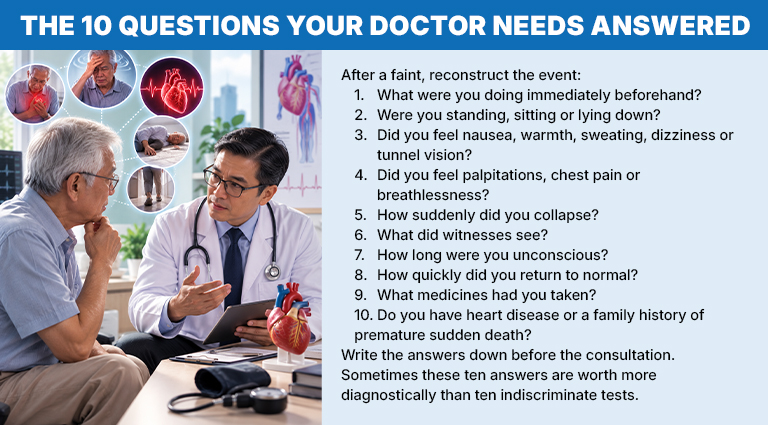
The history may reveal the diagnosis. What was the patient doing? Standing? Urinating? Coughing? Exercising? Turning the neck? Was there emotional distress? Heat? Dehydration? Did symptoms occur immediately after standing? Was there nausea and sweating? Or did the patient simply drop without warning? What medications were taken? What did witnesses see? How quickly did recovery occur?
These clues can be extraordinarily powerful.
More Testing Is Not Always Better
A person faints and understandably wants everything checked.
· CT scan.
· MRI.
· EEG.
· Carotid ultrasound.
· Blood tests.
· Echocardiogram.
· Holter monitor.
But testing should be targeted.
ACC/AHA/HRS guidance specifically states that routine comprehensive laboratory testing is generally not useful. Routine cardiac imaging is not useful unless a cardiac cause is suspected. Routine neurologic imaging or EEG is not recommended without neurological indications.
Depending on the story, however, additional testing may be appropriate.
An echocardiogram may be indicated when structural heart disease is suspected. Continuous or ambulatory ECG monitoring may be useful when arrhythmia is suspected. For rare unexplained episodes, prolonged monitoring—including an implantable loop recorder in selected patients—may eventually capture the responsible rhythm.
A tilt-table test can help selected patients when reflex syncope or orthostatic mechanisms remain suspected but uncertain.
Blood tests are ordered when the clinical picture points toward problems such as anemia or bleeding, metabolic abnormalities, myocardial ischemia or pulmonary embolism.
The objective is not to perform the greatest number of tests. It is to perform the right test on the right patient.
Treat the Cause, Not the Collapse
There is no universal “anti-fainting medicine.” Treatment depends on mechanism.
For Vasovagal Syncope
Education is often the foundation.
Learn the triggers.
Maintain appropriate hydration.
Avoid prolonged standing when possible.
Recognize warning symptoms early.
If the familiar nausea, warmth or tunnel vision begins, sit or lie down before consciousness is lost.
Physical counter-pressure maneuvers—such as leg crossing and sustained muscle tensing—can help some patients who have enough warning time.
Frequent or severe recurrent cases require individualized assessment and occasionally medication or device therapy in carefully selected circumstances.
For Orthostatic Hypotension
Look for the cause.
Is the patient dehydrated?
Are medications lowering pressure excessively?
Is there anemia or blood loss?
Is autonomic dysfunction present?
Treatment may involve hydration, careful medication review, slower positional changes, compression garments and, in selected patients, medications that support blood pressure.
A modern mechanism-based approach emphasizes tailoring therapy to whether hypotension or excessive bradycardia predominates rather than treating all non-cardiac syncope identically.
Do not simply stop antihypertensive medication on your own. The solution may be adjusting dose, timing or drug choice—not abandoning blood-pressure control.
For Cardiac Syncope
Here treatment can be lifesaving.
A significant bradyarrhythmia may require a pacemaker.
Certain dangerous tachyarrhythmias may require medication, catheter ablation or an implantable cardioverter-defibrillator (ICD) depending on the underlying disease and risk.
Severe structural heart disease requires treatment directed at the lesion.
The ACC/AHA/HRS guideline specifically recognizes pacing and ICD therapy in selected patients according to the underlying mechanism and cardiac condition.
The Consequences Go Beyond the Medical Cause
Even “benign” recurrent syncope can become a major quality-of-life problem.
People become afraid to drive, exercise, travel alone, take a shower behind a locked door, and afraid that the next faint will occur while holding a grandchild or crossing a road.
Falls can cause fractures and head injuries.
Repeated episodes may interfere with employment and independence.
Driving deserves particular caution because rules and recommendations vary according to the cause of syncope, recurrence risk, whether adequate treatment has been established, and local regulations.
Someone with unexplained or high-risk syncope should discuss driving explicitly with the treating physician rather than deciding that feeling well the next morning means driving is automatically safe.
How to Reduce Your Risk of Another Faint
If your physician has established a benign reflex or orthostatic mechanism, practical habits can help.
Rise gradually from bed—particularly first thing in the morning.
Sit on the edge of the bed briefly before standing if you are prone to orthostatic symptoms.
Maintain adequate hydration unless your physician has restricted fluids because of heart, kidney or another medical condition.
Avoid prolonged standing and excessive heat if these trigger episodes.
Do not skip meals if that contributes to feeling unwell, although true hypoglycemia is a different mechanism from syncope.
Review medications regularly, particularly after new drugs or dose changes.
At the first familiar warning symptom, get low before you go low—sit or lie down before falling.
Older people should also reduce environmental injury risks: slippery floors, loose rugs, poor bathroom lighting and hard furniture edges can transform a brief faint into a catastrophic injury.
The Faint That Could Be Your Heart’s Warning
The most dangerous mistake in syncope is assuming that because consciousness returned, the danger disappeared.
Cardiac syncope may be episodic. Between events, the patient may feel entirely normal.
A transient arrhythmia can start, dramatically reduce cardiac output, cause unconsciousness—and terminate spontaneously before the patient reaches the hospital.
This is why a normal pulse several hours later does not necessarily exclude an arrhythmic cause.
Particularly concerning is sudden syncope associated with exertion, structural heart disease, significant ECG abnormalities, palpitations, or a family history suggesting premature sudden cardiac death.
The appropriate message is not that every faint needs hospitalization.
It is that every faint deserves enough evaluation to determine whether it belongs to a low-risk or high-risk story.
Syncope in Seniors: When a “Simple Fall” Isn’t Simple
For an older person, the most dangerous word after a fall may be: “Nadapa lang.”
Sometimes that is exactly what happened. But sometimes the fall was preceded by transient loss of consciousness that nobody witnessed and the patient cannot remember.
Older adults also accumulate potential causes: dehydration, autonomic dysfunction, structural heart disease, arrhythmias and multiple medications.
The consequences are greater as well. A fall can mean a fractured hip, head injury, hospitalization, deconditioning and loss of independence.
That is why recurrent unexplained falls in an older adult deserve careful consideration of cardiovascular causes alongside neurological, musculoskeletal, visual and environmental ones.
Preventing the next fall may require more than a walking aid. It may require finding the reason consciousness was lost.
REFERENCES
1. Shen W-K, Sheldon RS, Benditt DG, et al. 2017 ACC/AHA/HRS Guideline for the Evaluation and Management of Patients With Syncope. Circulation. 2017;136:e60-e122. doi:10.1161/CIR.0000000000000499.
2. Shen W-K, Sheldon RS, Benditt DG, et al. 2017 ACC/AHA/HRS Guideline for the Evaluation and Management of Patients With Syncope: Executive Summary. J Am Coll Cardiol. 2017;70:620-663. doi:10.1016/j.jacc.2017.03.002.
3. Brignole M, Moya A, de Lange FJ, et al. 2018 ESC Guidelines for the diagnosis and management of syncope. Eur Heart J. 2018;39:1883-1948.
4. Brignole M, Moya A, de Lange FJ, et al. Practical Instructions for the 2018 ESC Guidelines for the diagnosis and management of syncope. Eur Heart J. 2018;39:e43-e80.
5. American Heart Association. Top Things to Know: 2017 Guideline for the Evaluation and Management of Patients with Syncope.
6. American College of Cardiology. Guideline Hub: Syncope. ACC clinical guidance resources.
7. Brignole M, Rivasi G, Fedorowski A. Mechanism-based therapy of non-cardiac syncope: a practical guide. Europace. 2024.










Leave a Reply