
HOME BLOOD PRESSURE MONITORING: ARE YOU DOING IT RIGHT?
Small mistakes can give big errors. Here’s how to get readings you and your doctor can trust.
By Marie Barrientos-Regala, MD
Q: Bakit pa ako magche-check ng BP sa bahay kung nagpapa-check naman ako sa doktor?
A: Clinic readings are just a snapshot. Some people’s blood pressure goes up only in the clinic because they’re anxious (“white coat hypertension”). Others have normal readings at the clinic but high readings at home or at work (“masked hypertension”). Home readings, taken over several days, give a much more accurate picture of your usual blood pressure and help your doctor adjust treatment. Many guidelines now recommend home monitoring for most people with hypertension.
Q: What kind of monitor should I buy?
A: Choose an automatic upper-arm monitor that has been clinically validated for accuracy. Wrist and finger monitors are generally less reliable. Make sure the cuff fits your arm — a cuff that’s too small gives falsely high readings, and one that’s too large gives falsely low ones. Many brands offer large cuffs for bigger arms.
Q: How do I prepare?
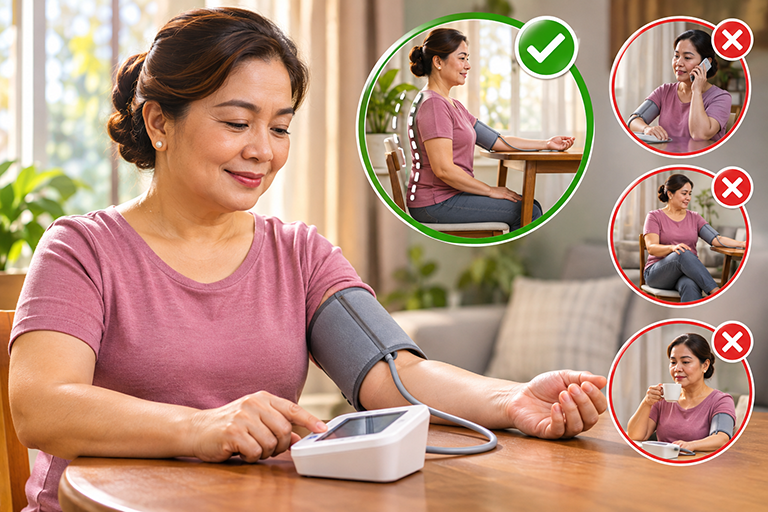
A: Before measuring:
• Avoid coffee, smoking and exercise for at least 30 minutes.
• Empty your bladder.
• Sit quietly for five minutes in a chair with back support, feet flat on the floor, legs uncrossed.
• Rest your arm on a table so the cuff is at heart level.
• Put the cuff on bare skin, not over clothing.
• Don’t talk or use your phone while measuring.
Q: When and how often should I measure?
A: A common approach is to take two readings, one minute apart, in the morning (before taking medicines and before breakfast) and two in the evening, for seven days before a clinic visit. Write down all readings, or use a monitor that stores them. Your doctor may suggest a different schedule.
Q: What numbers should worry me?
A: For many adults, a home blood pressure average of 135/85 mmHg or higher suggests hypertension. Your doctor will set your personal target, often lower for people with diabetes, kidney disease or heart disease. A single high reading isn’t usually cause for alarm, but a very high reading — around 180/120 or higher — especially with chest pain, shortness of breath, severe headache, confusion, weakness or vision changes, needs urgent medical attention.
Q: Should I adjust my medicine based on my home readings?
A: Not on your own. Bring your log to your doctor, who will decide whether your treatment needs to change. Never stop or double your medicines without advice.
Q: Gaano kadalas ko dapat i-check ang accuracy ng monitor ko?
A: Bring your monitor to your clinic once a year to compare its readings with your doctor’s device. Replace the cuff if it’s cracked or no longer closes properly.
Common mistakes that raise readings: a cuff that’s too small, an arm hanging at your side, crossed legs, talking during the measurement, a full bladder, or measuring right after coffee or a cigarette. Each can add several points — sometimes more — to your reading.








Leave a Reply