
THE 128,000 WHO DON’T KNOW
HIV diagnoses fell this year. But the virus hasn’t gone anywhere — and young Filipinos are still carrying the heaviest burden

PLUS
- Sidebar: HIV in the Philippines at a Glance
- Sidebar: How Far We Are From 95-95-95
- Sidebar: Myths That Keep People From Testing
- Getting Tested: Easier, Faster and More Private Than You Think
- PrEP, PEP and the New Long-Acting Options
- Undetectable = Untransmittable: Living Long and Well With HIV
- Talking to Your Teenager About HIV
- Commentary: Fewer Diagnoses Is Not the Same as Fewer Infections
- Doctor’s Note: The Word My Patient Couldn’t Say
Just a year ago, health officials warned that the Philippines had the fastest-growing HIV epidemic in the Asia-Pacific, with 57 Filipinos diagnosed every day and nearly a third of them under 25. This year, the numbers look better: new diagnoses in the second quarter fell 39 percent. But behind that headline is a sobering estimate. Of the roughly 288,000 Filipinos believed to be living with HIV, only 56 percent have been diagnosed. About 128,000 people may have the virus and not know it. As World AIDS Day approaches, here is what every family should understand about HIV today: how it spreads, how easily it can now be tested, prevented and treated — and why stigma remains its most dangerous ally.
By Rebecca Lorenzo-Castillo, MD
The test he kept postponing
He was 23, a fresh graduate working his first job in Makati. For two years, a small worry had followed him around. He’d read about HIV on social media. He knew he should get tested. He even saved the address of a community clinic on his phone.
But he never went.
He told himself he was too busy. The truth was that he was afraid — afraid of the result, afraid someone would see him walk in, afraid his parents would find out, afraid of what his officemates would think. So he did what many young Filipinos do. He waited, and hoped.
When he finally got tested, it was because he had been sick for weeks with fever, weight loss and a cough that wouldn’t go away. He was diagnosed with HIV and tuberculosis at the same time. His immune system had already been badly damaged.
He survived, and today he is on treatment and doing well. But he lost two years in which the virus quietly harmed his body — and in which, without knowing it, he might have passed it on.
His story is a composite, but it reflects a reality the DOH’s own numbers make plain. In the second quarter of this year, 28 percent of newly diagnosed Filipinos already had advanced HIV disease at the time of diagnosis. They were found late. Too late to avoid the damage, though not too late to treat.
Where the numbers stand
The Philippines has been fighting a growing HIV epidemic for over a decade.
According to WHO and UNAIDS, new HIV cases in the country rose by about 550 percent between 2010 and 2024, from roughly 4,400 to 29,600 a year — the fastest growth in the Asia-Pacific region. In 2025, the DOH reported an average of 57 new diagnoses a day, and the Health Secretary at the time told Congress that nearly a third of new cases were young people.
This year, the trend appears to have turned, at least on paper. The DOH’s HIV/AIDS and ART Registry of the Philippines reported:
• 4,633 new cases in the first quarter of 2026.
• 2,994 new cases from April to June 2026 — 39 percent lower than the same quarter last year, an average of 33 a day.
• 171,066 confirmed cases in total since the first Filipino case in 1984.
That decline is welcome. But it needs careful reading, and it doesn’t mean the epidemic is over. (See our commentary.) Fewer diagnoses can mean fewer infections — or it can mean fewer people are getting tested.
What we do know is this: the DOH estimates that about 288,000 Filipinos were living with HIV by early 2026. Only 159,997 — about 56 percent — had been diagnosed. That leaves roughly 128,000 people who may have HIV without knowing it.
Who is affected
HIV can affect anyone. But in the Philippines, the epidemic is concentrated:
• Young people. In the second quarter of 2026, nearly one in three new cases (31 percent) were aged 15 to 24. The median age of new cases was 28.
• Men. About 96 percent of new cases were male.
• Sexual transmission. About 91 percent of new cases were acquired through sexual contact, the majority among men who have sex with men.
• Urban centers — led by Metro Manila, Calabarzon and Central Luzon — though every region reports cases.
Cases among children remain rare but are not zero. In the second quarter, nine cases were from mother-to-child transmission, all of them preventable with testing and treatment during pregnancy.
What HIV does — and what it no longer has to do
HIV, the human immunodeficiency virus, attacks the immune system, particularly the CD4 cells that help the body fight infection. Without treatment, the virus slowly destroys these cells over years, often without obvious symptoms. Eventually, the immune system becomes so weak that infections and cancers it would normally fight off can take hold. That late stage is called AIDS.
That was the story of HIV in the 1980s and 1990s, when a diagnosis felt like a death sentence.
It isn’t anymore.
Today, antiretroviral therapy (ART), usually taken as one pill a day, can control the virus so well that it becomes undetectable in the blood. People who start treatment early and stay on it can expect to live close to a normal lifespan. And, as large international studies have shown, people with HIV whose viral load stays undetectable do not transmit the virus to sexual partners. That’s the principle behind the message “Undetectable = Untransmittable,” or U=U.
ART is available free of charge at DOH-designated HIV treatment hubs and primary HIV care facilities across the country, and PhilHealth covers outpatient HIV treatment.
The new tools of prevention
Prevention has also changed dramatically:
• Condoms remain highly effective and widely available.
• PrEP (pre-exposure prophylaxis) — medicine taken by HIV-negative people before possible exposure — greatly reduces the risk of infection when used as directed. More than 107,000 Filipinos have enrolled in PrEP since 2021, with nearly 9,700 new enrollees in the second quarter of 2026 alone.
• PEP (post-exposure prophylaxis) — a 28-day course of medicine started within 72 hours after a possible exposure — can prevent infection.
• Long-acting options. In 2025, WHO recommended lenacapavir, an injection given just twice a year, as an additional PrEP option. It isn’t yet widely available in the Philippines, but it may change prevention in the years ahead.
• Testing and treatment during pregnancy can almost entirely prevent transmission from mother to baby.
(See our supplemental article for details.)
The biggest barrier isn’t the virus
If testing is easy, treatment is free and prevention works, why is HIV still spreading?
The answer, again and again, is stigma.
Young people delay testing because they fear being seen, judged, outed or rejected. Families react with shame or anger instead of support. Some health workers, despite training, still treat people with HIV differently. Employers and schools sometimes discriminate, even though the law prohibits it. Misinformation persists — that HIV spreads through sharing food, that only “certain kinds of people” get it, that a diagnosis means death.
Stigma doesn’t just hurt feelings. It keeps people from getting tested, from starting treatment, and from staying on it. It keeps the virus hidden — and hidden viruses spread.
The Philippine HIV and AIDS Policy Act of 2018 (Republic Act 11166) was designed to change this. It protects the confidentiality of HIV status, prohibits discrimination, and allows young people aged 15 to 17 to consent to HIV testing on their own, without parental consent, so that fear of family reaction doesn’t stop them from finding out their status.
What every Filipino can do
• Get tested at least once, and regularly if you’re at higher risk. It’s free, confidential and fast at many health centers and community clinics. HIV self-test kits are also available.
• Know your prevention options: condoms, PrEP, PEP.
• If you test positive, start treatment early and stay on it. It works.
• If you’re pregnant, get tested as part of routine prenatal care.
• Talk to your children about HIV and sexual health — honestly, early and without shame.
• Fight stigma with facts. Correct misinformation. Treat people living with HIV with the same respect and kindness you’d show anyone with a chronic illness.
• Support people who disclose their status to you. The way you respond may decide whether they stay in care.
A final word
We have come an extraordinarily long way since the first Filipino HIV case was reported in 1984. A virus that once meant certain death is now a manageable chronic condition. Prevention tools that were unimaginable a generation ago are now available free of charge.
What we have not yet beaten is fear — the fear that keeps 128,000 Filipinos from knowing their status, and keeps too many from starting treatment until they are already sick.
This World AIDS Day, the most powerful thing we can offer is not a new drug. It’s a culture in which getting tested is as ordinary as checking your blood pressure, and in which a positive result is met not with shame, but with care.
“A virus that once meant certain death is now a manageable condition. What we have not yet beaten is fear — the fear that keeps 128,000 Filipinos from knowing their status.”
HIV IN THE PHILIPPINES AT A GLANCE
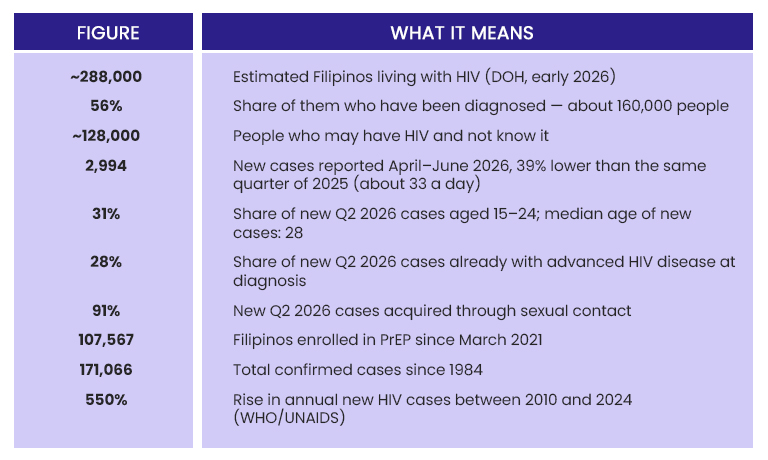
Sources: DOH HIV/AIDS & ART Registry of the Philippines (HARP), Q2 2026 report; WHO Philippines and UNAIDS joint statement, June 11, 2025.
HOW FAR WE ARE FROM 95-95-95
UNAIDS has set global targets for ending AIDS as a public health threat by 2030: 95 percent of people living with HIV know their status; 95 percent of those diagnosed are on treatment; and 95 percent of those on treatment have a suppressed viral load.
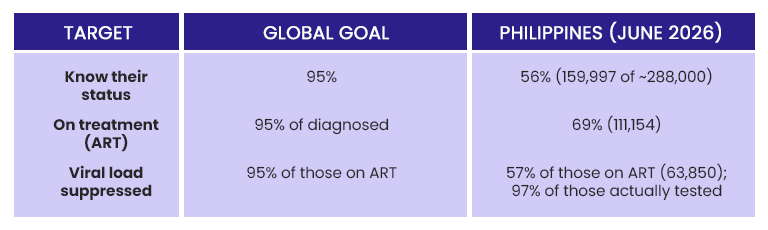
What the numbers tell us: Treatment works — 97 percent of people on ART who had their viral load tested were suppressed. The biggest gaps are earlier in the chain: finding people who don’t know they have HIV, linking them to treatment, and making sure everyone on treatment gets their viral load checked.
Source: DOH HARP Q2 2026 care cascade.
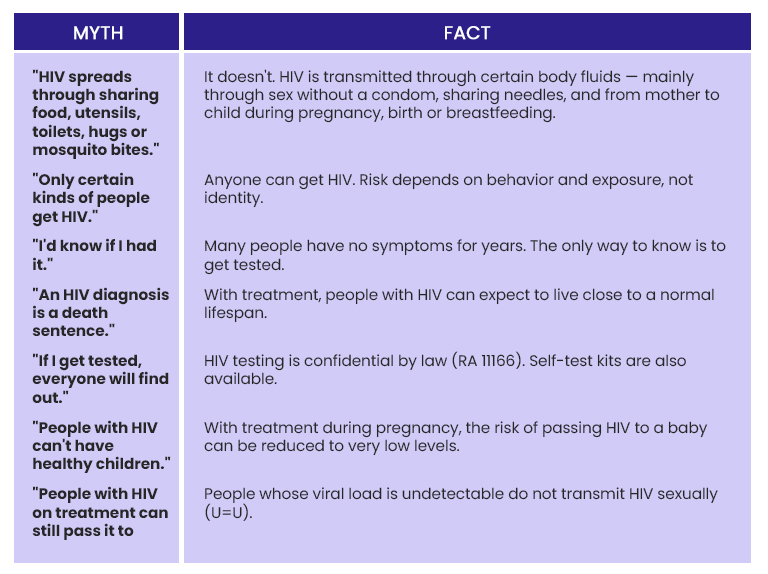
MYTHS THAT KEEP PEOPLE FROM TESTING
KEY REFERENCES
1. Department of Health, Epidemiology Bureau. HIV/AIDS & ART Registry of the Philippines (HARP), April–June 2026. Manila: DOH; 2026.
2. “DOH records 3,000 new HIV cases in 2nd quarter of 2026.” SunStar Manila, August 26, 2026.
3. “HIV cases in the Philippines surpass 4,000 in just 3 months” (DOH-Epidemiology Bureau Q1 2026 data). PhilNews, July 21, 2026.
4. WHO Philippines. “UNAIDS, WHO support DOH’s call for urgent action as the Philippines faces the fastest-growing HIV surge in the Asia-Pacific region.” June 11, 2025.
5. “57 new HIV cases reported daily; 30% are under 18 — DOH.” GMA News Online, September 4, 2025.
6. “Only 56% of estimated 288,000 PLHIV have been diagnosed — DOH.” Philippine Daily Inquirer, 2026.
7. Republic Act No. 11166: Philippine HIV and AIDS Policy Act of 2018.
8. UNAIDS. Understanding fast-track: accelerating action to end the AIDS epidemic by 2030 (95-95-95 targets). Geneva: UNAIDS.
9. Cohen MS, Chen YQ, McCauley M, et al. Antiretroviral therapy for the prevention of HIV-1 transmission (HPTN 052). N Engl J Med. 2016;375(9):830–839.
10. Rodger AJ, Cambiano V, Bruun T, et al. Risk of HIV transmission through condomless sex in serodifferent gay couples with the HIV-positive partner taking suppressive antiretroviral therapy (PARTNER): final results. Lancet. 2019;393(10189):2428–2438.
11. World Health Organization. Guidelines on lenacapavir for HIV prevention and testing strategies for long-acting injectable pre-exposure prophylaxis. Geneva: WHO; July 2025.
12. Grinspoon SK, Fitch KV, Zanni MV, et al. Pitavastatin to prevent cardiovascular disease in HIV infection (REPRIEVE). N Engl J Med. 2023;389(8):687–699.
13. Marcus JL, Leyden WA, Alexeeff SE, et al. Comparison of overall and comorbidity-free life expectancy between insured adults with and without HIV infection, 2000–2016. JAMA Netw Open. 2020;3(6):e207954.
14. World Health Organization. Consolidated guidelines on HIV prevention, testing, treatment, service delivery and monitoring. Geneva: WHO; 2021.
GETTING TESTED
Easier, faster and more private than you think
By the H&L Editorial Team
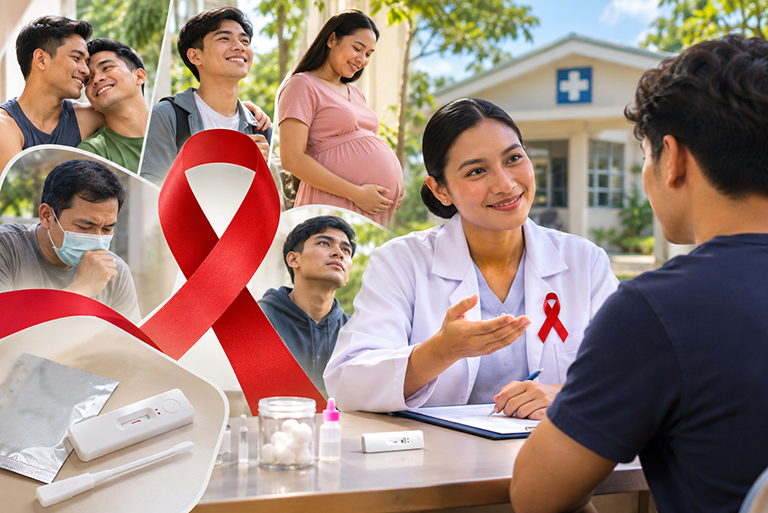
For many Filipinos, the hardest part of an HIV test isn’t the needle. It’s walking through the door.
The good news is that testing has never been easier, quicker or more confidential.
Who should get tested?
• Everyone aged 15 and older should be tested at least once.
• People at higher risk should test regularly — every three to six months — including men who have sex with men, people with multiple partners, people who have had a sexually transmitted infection, and people who share needles.
• Pregnant women, as part of routine prenatal care.
• Anyone diagnosed with tuberculosis or another sexually transmitted infection.
• Anyone who thinks they may have been exposed.
Where to get tested
• Rural health units and city health centers, many of which offer free HIV testing.
• Social hygiene clinics in many cities.
• DOH-designated HIV treatment hubs in hospitals.
• Community-based organizations, which often offer testing in friendly, judgment-free settings, sometimes with evening and weekend hours.
• HIV self-test kits, which allow people to test privately at home using an oral swab or a finger-prick. A reactive self-test must be confirmed at a health facility.
What happens during a test
Most initial tests use a rapid test with a small drop of blood from a finger prick. Results are usually ready in about 15 to 20 minutes. A counselor explains the result and what it means.
• A non-reactive (negative) result means no HIV was detected. If you had a possible exposure in the last few weeks, you may need a repeat test later, because there’s a “window period” before HIV can be detected.
• A reactive result means further testing is needed to confirm. If HIV is confirmed, you’ll be linked to care and treatment — usually the same day or soon after.
Your rights
Under the Philippine HIV and AIDS Policy Act (RA 11166):
• HIV testing is voluntary and confidential. Your results can’t be disclosed without your consent, except in specific circumstances defined by law.
• Young people aged 15 to 17 can consent to HIV testing on their own, without needing a parent’s permission.
• Discrimination based on HIV status is prohibited in employment, schools, health care and other settings.
• Mandatory HIV testing for employment, school admission or travel is generally prohibited.
Your first step: Look up the nearest testing site in your city, or ask your barangay health center. Testing takes less than half an hour. Knowing your status — whatever it is — puts you back in control.
PREP, PEP AND THE NEW LONG-ACTING OPTIONS
The prevention toolkit has never been stronger
By Reuben Ricallo

For decades, HIV prevention meant one main message: use a condom. Condoms remain one of the most effective tools. But today, people have more options than ever.
PrEP: prevention before exposure
Pre-exposure prophylaxis (PrEP) is medicine taken by people who are HIV-negative to prevent infection.
• How it works: The most common form is a daily pill containing two antiretroviral drugs. Some people at certain risks may use an “event-driven” schedule under medical guidance.
• How well it works: When taken as prescribed, PrEP is highly effective at preventing sexual transmission of HIV.
• Who it’s for: People at substantial risk of HIV, such as those with an HIV-positive partner who is not yet virally suppressed, people with multiple partners, men who have sex with men, and people who inject drugs.
• In the Philippines: PrEP is available at many DOH treatment hubs and community clinics, often free. More than 107,000 Filipinos have enrolled since 2021.
• Important: PrEP doesn’t protect against other sexually transmitted infections, so condoms are still recommended. Regular HIV and kidney function tests are part of PrEP care.
PEP: prevention after exposure
Post-exposure prophylaxis (PEP) is a 28-day course of HIV medicines taken after a possible exposure — for example, after condomless sex with a partner of unknown status, after sexual assault, or after a needle-stick injury.
• It must be started within 72 hours — the sooner, the better.
• Go to a hospital emergency room, HIV treatment hub or community clinic immediately if you think you’ve been exposed.
Long-acting options: the next frontier
In 2025, WHO recommended lenacapavir, an injection given just twice a year, as an additional option for HIV prevention. In large clinical trials, it was extremely effective.
Long-acting options could help people who find taking a daily pill difficult. Lenacapavir is not yet widely available in the Philippines, and cost and access remain major questions. But it represents a significant step forward.
Other prevention tools
• Condoms — protect against HIV and other sexually transmitted infections.
• Treatment as prevention — people with HIV who are on treatment and have an undetectable viral load don’t transmit HIV sexually.
• Prevention of mother-to-child transmission — testing and treatment during pregnancy, safe delivery and appropriate infant feeding.
• Not sharing needles or syringes.
Ask about PrEP if: You’re HIV-negative and at ongoing risk of exposure. A health worker can help you decide whether it’s right for you, and what tests you need first.
UNDETECTABLE = UNTRANSMITTABLE
Living long and well with HIV — and why your heart now matters too
By Rebecca Lorenzo-Castillo, MD
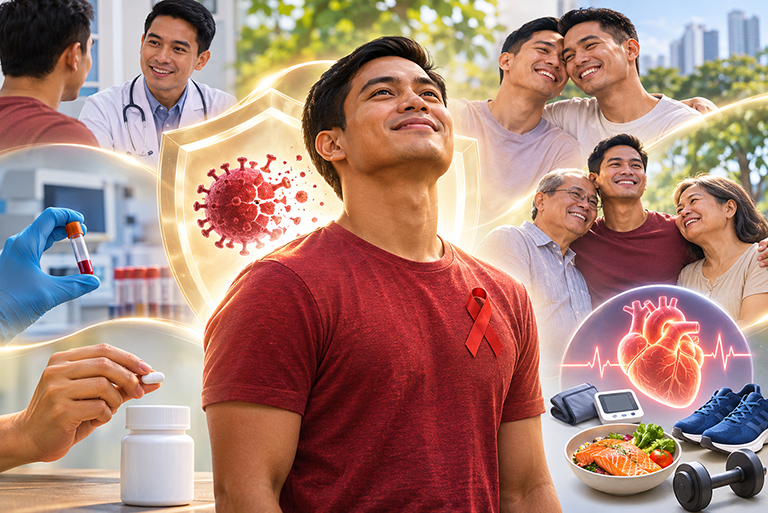
For people diagnosed with HIV today, the most important message is simple: treatment works.
What antiretroviral therapy does
Antiretroviral therapy (ART) doesn’t cure HIV, but it stops the virus from multiplying. Over a few months, the amount of virus in the blood — the viral load — drops so low that standard tests can’t detect it. The immune system then has a chance to recover.
People who start ART early and take it consistently can expect to live close to a normal lifespan. Many work, raise families and grow old with HIV.
In the Philippines, ART is free at DOH-designated treatment hubs and primary HIV care facilities, and PhilHealth’s outpatient HIV/AIDS treatment package helps cover care.
What U=U means
Large international studies — including the HPTN 052 and PARTNER studies — followed thousands of couples in which one partner had HIV and the other didn’t. When the partner with HIV was on treatment and had a durably undetectable viral load, there were no cases of sexual transmission linked to that partner.
That finding is the basis of U=U: Undetectable = Untransmittable. It’s one of the most powerful messages against stigma, because it means people with HIV on effective treatment can have relationships without fear of transmitting the virus sexually.
Staying undetectable
• Take ART every day, as prescribed.
• Get your viral load checked regularly — at least once a year, and more often when starting treatment. In the Philippines, only about 59 percent of people on ART had a viral load test in the past year, according to DOH data. If you haven’t been tested, ask your treatment hub.
• Don’t stop treatment without talking to your doctor, even if you feel well.
• Tell your doctor about other medicines and supplements, since some interact with ART.
Aging with HIV: the heart matters
As people with HIV live longer, they face the same chronic illnesses as everyone else — and some at higher rates. People with HIV have a higher risk of heart disease and stroke, partly due to ongoing inflammation even when the virus is controlled.
The landmark REPRIEVE trial, published in 2023, found that a daily statin (pitavastatin) reduced major cardiovascular events by about 35 percent in people with HIV who had low-to-moderate cardiovascular risk. That has led international guidelines to recommend statins for many adults with HIV.
So care for people with HIV now includes checking blood pressure, cholesterol and blood sugar, stopping smoking, staying active, and eating well — just as it does for anyone who wants a long, healthy life.
For families: If someone you love has HIV, the best thing you can do is support them in staying on treatment. Remind them of appointments. Learn the facts. And treat them exactly as you always have: as family.
TALKING TO YOUR TEENAGER ABOUT HIV
Awkward? Maybe. Necessary? Absolutely.
By Marie Barrientos-Regala, MD
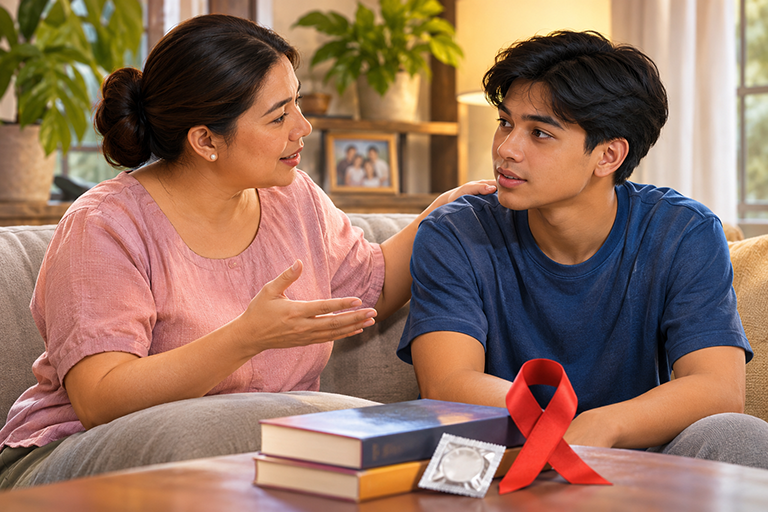
Many Filipino parents would rather talk about almost anything than sex and HIV with their children. Some fear it will encourage early sexual activity. Others simply don’t know how to begin.
But the data are clear: nearly a third of new HIV diagnoses in the Philippines are among young people aged 15 to 24. Many young people are learning about sex and relationships from social media, friends and dating apps — sources that are often incomplete or wrong. Parents who stay silent leave that space to others.
Research consistently shows that honest, age-appropriate conversations about sexual health don’t lead teenagers to have sex earlier. They help young people make safer, more informed choices.
Tips for starting the conversation
• Start early and keep it ongoing. It’s not one big talk but many small ones, adjusted as your child grows.
• Use everyday openings. A news story, a TV show, a school lesson or this World AIDS Day can be a natural way in.
• Get the facts first. Learn how HIV is and isn’t transmitted, and how it can be prevented and treated.
• Listen more than you lecture. Ask what they already know and what they’ve heard. Correct myths calmly.
• Talk about values and relationships, not just risks — respect, consent, and the right to say no.
• Talk about online safety. Discuss the risks of meeting strangers from the internet and sharing personal photos.
• Make it safe to come to you. Let your teenager know that they can always ask you questions or come to you for help, without fear of punishment or shame.
• Know their rights. Under RA 11166, young people aged 15 to 17 can get tested for HIV without parental consent. That’s meant to remove barriers to testing, not to cut parents out. A teenager who trusts their parents is more likely to involve them.
If your child tells you they have HIV
• Stay calm and listen. Your first reaction matters enormously.
• Tell them you love them. Say it out loud.
• Focus on next steps: treatment, support and their health.
• Respect their privacy. Don’t share their status without their permission.
• Get support for yourself too, from a counselor, support group or trusted spiritual adviser.
A conversation starter: “I read that a lot of young people in the Philippines are getting HIV, and many don’t know it. What do they teach you about it in school? Is there anything you’d want to ask me?”
PUBLIC HEALTH COMMENTARY
FEWER DIAGNOSES IS NOT THE SAME AS FEWER INFECTIONS
By Rafael R. Castillo, MD

When the DOH reported that new HIV diagnoses in the second quarter of 2026 had fallen 39 percent compared with the same quarter last year, it was tempting to celebrate.
Celebration would be premature.
A drop in diagnoses can mean two very different things. It can mean fewer people are being infected — the result of better prevention, more PrEP and more people on effective treatment. Or it can mean fewer people are being tested, so infections are happening but not being found.
The data we have can’t fully tell those two apart. Several signals counsel caution:
• Most Filipinos with HIV still haven’t been diagnosed. Only 56 percent of the estimated 288,000 people living with HIV know their status. A falling number of diagnoses, against that backdrop, may reflect missed cases.
• Many people are diagnosed late. Nearly 28 percent of new cases in the second quarter already had advanced HIV disease. Late diagnosis is a sign that testing isn’t reaching people early enough.
• International funding has shifted. Global HIV programs have faced funding cuts and disruptions since 2025, and the DOH itself has acknowledged that some foreign-funded programs were delayed. Community-based testing, often supported by such funding, is especially vulnerable.
• Prevention has long been underfunded. WHO and UNAIDS noted that prevention received only about 6 percent of HIV spending in 2023.
None of this takes away from real progress. PrEP enrollment continues to grow. Treatment, once started, works extremely well. Dedicated health workers and community organizations have done remarkable work.
But if we want to know whether the epidemic is truly slowing, we need to measure it properly — and we need to keep looking for the 128,000 people who don’t yet know they have HIV.
What would that take?
• Sustained, domestic funding for prevention and testing, especially community-based testing that reaches young people and key populations.
• Wider access to HIV self-testing, so people can test privately.
• Integrating HIV testing into routine care — in TB clinics, prenatal care, STI services and general outpatient visits.
• Faster linkage to treatment after diagnosis, and support to stay in care.
• Universal viral load testing for everyone on treatment.
• Comprehensive sexuality education in schools, as provided under the law.
• Real action on stigma and discrimination, in health facilities, workplaces, schools and families.
• Better data: regular estimates of new infections, not just new diagnoses, and reporting of testing volumes so we can interpret trends correctly.
World AIDS Day is a time to remember those we have lost and to honor those living with HIV. It should also be a time for honesty. A falling number on a chart is encouraging. But until we find the people who don’t know their status, we can’t call the job done.



Leave a Reply