


Can the Philippines Build a World-Class Semiconductor Industry Without Compromising Public Health?
An evidence-based examination of the health, environmental, occupational, and economic implications of advanced semiconductor manufacturing in the Philippines
By Rafael R. Castillo, MD
The global race for microchip supremacy has reached the shores of the Philippines. Under the United States-led Pax Silica framework—a strategic initiative designed to re-shore and diversify advanced technology supply chains—the Philippines is positioning itself as a central hub within the Luzon Economic Corridor.
A proposed 1,600-hectare high-tech complex in New Clark City, Tarlac, aims to elevate the nation’s longstanding role in back-end assembly and testing into high-value semiconductor manufacturing. However, this industrial ambition brings intense scrutiny regarding public health, occupational safety, and ecological sustainability.
Beyond economic promise lies a complex toxicological reality: semiconductor fabrication involves hundreds of hazardous chemicals, heavy metals, volatile organic compounds, and per- and polyfluoroalkyl substances (PFAS), alongside extreme water and energy demands.
This article presents a comprehensive, evidence-based medical and policy appraisal of the health, environmental, and socio-economic trade-offs of Pax Silica.
Balancing Economic Ambition and Public Protection
The announcement of the Pax Silica initiative has sparked intense debate across the economic, environmental, and public health sectors of the Philippines. Proponents argue that hosting microchip component manufacturing under the Luzon Economic Corridor framework provides a generational opportunity to transition from low-margin assembly to high-value technology production, creating thousands of specialized engineering jobs and attracting substantial foreign direct investment.
However, civil society groups, agricultural collectives, and health experts have raised significant concerns regarding resource allocation, land conversion, and public health safeguards. Central Luzon, often termed the “Rice Granary of the Philippines,” relies heavily on the arable land and river basins surrounding Tarlac and Pampanga. The potential conversion of agricultural land for industrial sites and associated energy infrastructure raises vital questions regarding long-term regional food security.
From a public health vantage point, the Philippine health system must prepare for the unique toxicological challenges presented by advanced industrial manufacturing. Primary health care units (Rural Health Units and Barangay Health Stations) in Central Luzon are currently equipped for infectious disease management, maternal-child health, and chronic lifestyle diseases. They lack specialized clinical toxicology training and diagnostic equipment to detect early occupational solvent neurotoxicity, heavy metal bioaccumulation, or subtle chemical-induced bone marrow suppression.
To ensure that industrial expansion under Pax Silica does not compromise worker safety or community health, national agencies must implement a series of structural safeguards:
1. Mandatory Baseline Health Registries: Prior to operationalizing any fabrication or advanced chemical processing plant, DOLE and the Department of Health (DOH) must establish a mandatory, prospective cohort registry for all factory personnel. This registry must track reproductive health outcomes, biological toxicant levels (e.g., urinary heavy metals, blood solvent metabolites), and oncologic incidence over multi-decade time horizons.
2. Strict Enforceability of Zero Liquid Discharge (ZLD): Environmental Compliance Certificates (ECCs) issued by the DENR-EMB must legally mandate high-efficiency ZLD recycling systems for all chip manufacturing units, making operational permits contingent on verified, real-time wastewater treatment benchmarks.
3. Community Water Rights Safeguards: Explicit statutory protections must guarantee that industrial water extraction never supersedes agricultural irrigation or municipal drinking water allocations during severe climate events or droughts.
4. Strengthened Occupational Health Standards: The Philippines must update its Permissible Exposure Limits (PELs) for airborne chemicals, replacing decades-old thresholds with contemporary evidence-based international standards (e.g., ACGIH Threshold Limit Values) that account for low-dose chemical mixture toxicities.
The Pax Silica project introduces a high-stakes trade-off for the Philippines: transformative economic growth versus serious public health and environmental risks.
Financial Gains
On the economic side, building advanced microchip fabrication plants (fabs) moves the Philippines up the technological ladder—shifting from low-margin assembly and testing to high-value manufacturing.
Global Standing: Positions the country as a critical player in the global semiconductor supply chain alongside the US and regional partners.
Capital & Infrastructure: Brings billions of dollars in foreign direct investment into the Luzon Economic Corridor and New Clark City.
High-Value Jobs: Creates thousands of direct and indirect jobs for engineers, scientists, and skilled technicians, boosting local tax revenues and regional development.
Health and Environmental Consequences
However, manufacturing microchips requires intense chemical processing and immense natural resources, bringing severe toxicological liabilities:
Occupational Hazards: Wafer fabrication relies on toxic solvents, heavy metals, corrosive acids (like hydrofluoric acid), and dangerous gases. Without strict protections, cleanroom workers face elevated risks of spontaneous abortion, reproductive harm, leukemia, lymphoma, and breast cancer.
Water and Community Health: A single fab consumes millions of liters of water daily. In Central Luzon, drawing this volume risks depleting local aquifers used by farmers. If wastewater containing “forever chemicals” (PFAS) or toxic solvents leaks into the soil or river basins, it can permanently contaminate drinking water and cause chronic community health issues.
Resource Strain: The project’s massive energy demands could strain the regional power grid and drive up local electricity costs.
The Bottom Line
Pax Silica offers the Philippines a multi-billion-dollar economic leap forward, but it carries legacy health and environmental costs. Securing these financial gains safely requires strict environmental enforcement, closed-loop water recycling, and modern worker protections.
“In a region that feeds millions, diverting tens of billions of liters of water and thousands of hectares of arable land for silicon processing creates a direct conflict between high-tech ambitions and basic food security.”
“We cannot import the economic benefits of advanced microchip manufacturing while leaving behind the stringent environmental and occupational safety protocols required to prevent chronic disease.”
References
1. United States Department of State. Fact Sheet: Launch of the Pax Silica Initiative and Inaugural Summit. Washington, D.C.: U.S. Department of State; 2025.
2. World Bank Group. Environmental, Health, and Safety Guidelines for Semiconductors and Other Electronics Manufacturing. Washington, D.C.: International Finance Corporation; 2007.
3. LaDou J. Occupational health in the semiconductor industry. Eur J Oncol. 2009;14(2):69-78.
4. Kim EA, Lee H, Kang SK. The health impacts of semiconductor production: an epidemiologic review. Front Public Health. 2014;2:136.
5. Mendoza TC. Pax Silica faces costly power, water and land trade-offs. Philippine Daily Inquirer. 2026 Aug 4.
6. CIO Southeast Asia. Pax Silica’s water question: can rainwater alone power a semiconductor hub? Economic Times CIO. 2026 Jul 27.
7. CHIPS Communities United. Toxic Workplace Chemicals: Not So Clean, Not So Green. Washington, D.C.: CCU Coalition Report; 2024.
8. Correa A, Gray RH, Cohen R, Rothman N, Shah F, Seacat H, et al. Ethylene glycol ethers and spontaneous abortion in semiconductor workers. Am J Epidemiol. 1996;143(7):707-717.
9. Schenker MB, Gold EB, Beaumont JJ, Eskenazi B, Hammond SK, Rasor MO, et al. Association of spontaneous abortion and other reproductive effects with work in the semiconductor industry. Am J Ind Med. 1995;28(6):639-659.
10. LaDou J. Printed circuit board manufacturing. Int J Occup Environ Health. 2006;12(3):252-258.
11. McElvenny DM, Darnton AJ, Hodgson JT, Clarke SM, Elliott RC, Cohen DL. Cancer incidence: report on the Health and Safety Executive’s investigation in relation to the National Semiconductor factory in East Kilbride. Occup Environ Med. 2003;60(12):e17.
12. Beall C, Bender TJ, Cheng H, Dougherty R, Su Y, Delzell E. Mortality among workers at a semiconductor manufacturing plant. J Occup Environ Med. 2005;47(10):996-1008.
13. Bender TJ, Beall C, Cheng H, Dougherty R, Su Y, Delzell E. Cancer incidence among workers at a semiconductor manufacturing plant. J Occup Environ Med. 2007;49(12):1297-1308.
14. Kim MH, Kim H, Choi S, Lee K. Occupational cancer in the semiconductor industry: a systematic review and meta-analysis. Scand J Work Environ Health. 2018;44(6):571-582.
15. Lee HE, Kim EA, Park J. Cancer risk among workers in the semiconductor industry in Korea: a mortality and incidence study. Am J Ind Med. 2015;58(2):121-129.
16. Hsieh GY, Wang JD, Cheng TJ, Chen PC. Pregnancy outcomes among female workers in the semiconductor industry in Taiwan. Occup Environ Med. 2005;62(9):622-629.
17. Sung TI, Wang JD, Chen PC. Increased risk of spontaneous abortion among female workers in the microelectronics industry. Int Arch Occup Environ Health. 2007;80(7):611-617.
18. Centers for Disease Control and Prevention (CDC). Hydrofluoric acid burns and systemic toxicity in industrial settings. MMWR Morb Mortal Wkly Rep. 2019;68(14):321-325.
19. Environmental Protection Agency (EPA). Toxicological Review of Trichloroethylene (TCE). Washington, D.C.: U.S. EPA; 2011.
20. Agency for Toxic Substances and Disease Registry (ATSDR). Toxicological Profile for Perfluoroalkyls. Atlanta, GA: U.S. Department of Health and Human Services; 2021.
21. Grandjean P, Clapp R. Perfluorinated alkyl substances: emerging insights into health risks. Environ Health. 2015;14:14.
22. World Health Organization (WHO). Ambient Air Quality Guidelines and Industrial Hazard Controls. Geneva: WHO Guidelines Approved by the Guidelines Review Committee; 2021.
23. Department of Labor and Employment (DOLE). Republic Act No. 11058: An Act Strengthening Compliance with Occupational Safety and Health Standards. Manila: Official Gazette of the Republic of the Philippines; 2018.
24. Department of Environment and Natural Resources (DENR). Republic Act No. 6969: Toxic Substances and Hazardous and Nuclear Wastes Control Act of 1990. Manila: DENR-EMB; 1990.
25. Department of Environment and Natural Resources (DENR). Republic Act No. 9275: The Philippine Clean Water Act of 2004. Manila: Official Gazette of the Republic of the Philippines; 2004.
26. Bases Conversion and Development Authority (BCDA). Comprehensive Sustainable Development Framework for New Clark City. Taguig City: BCDA Infrastructure Division; 2025.
27. Department of Trade and Industry (DTI). Philippine Semiconductor and Electronics Industry Strategic Roadmap 2030. Makati City: DTI-BOI; 2024.
28. Semiconductor and Electronics Industries in the Philippines Foundation, Inc. (SEIPI). Annual Industry Performance and Supply Chain Outlook. Muntinlupa City: SEIPI Board Report; 2025.
29. Watterson A. Occupational and environmental health hazards in the electronics industry: policy gaps and solution frameworks. Environ Health Perspect. 2016;124(8):1120-1127.
30. Smith Ted, Sonnenfeld DA, Pellow DN, editors. Challenging the Chip: Labor Rights and Environmental Justice in the Global Electronics Industry. Philadelphia: Temple University Press; 2006.
31. Clapp R, Ozonoff D. Environment and health: vital linkages in high-tech manufacturing corridors. Am J Public Health. 2004;94(5):712-714.
32. European Chemicals Agency (ECHA). Restriction Proposal on Per- and Polyfluoroalkyl Substances (PFAS) in Semiconductor Manufacturing. Helsinki: ECHA Regulatory Report; 2023.
33. National Institute for Occupational Safety and Health (NIOSH). Occupational Exposure to Gallium Arsenide and Indium Phosphide. Cincinnati, OH: U.S. Department of Health and Human Services, CDC, NIOSH; 2017.
34. American Conference of Governmental Industrial Hygienists (ACGIH). Threshold Limit Values (TLVs) and Biological Exposure Indices (BEIs). Cincinnati, OH: ACGIH; 2025.
35. International Agency for Research on Cancer (IARC). Monograph 106: Trichloroethylene, Tetrachloroethylene, and Some Other Chlorinated Agents. Lyon: World Health Organization, IARC; 2014.
36. IARC. Monograph 110: Some Industrial Chemicals (Including Glycol Ethers). Lyon: World Health Organization, IARC; 2017.
37. Park DU, Yang HA, Lee KW. Health hazard evaluations in the semiconductor manufacturing industry: solvent exposures and health endpoints. Safety Health Work. 2011;2(2):125-134.
38. Kim S, Chang SJ. Cancer patterns among electronics production workers in East Asia: a comparative review. Asian Pac J Cancer Prev. 2017;18(4):889-897.
39. Lin YP, Chen PC. Reproductive outcomes among workers in high-tech industries: a population-based study. J Occup Health. 2012;54(3):201-209.
40. Tseng CH. Environmental water extraction and aquifer depletion risks in microelectronics industrial parks. Water Resour Manage. 2020;34(9):2845-2859.
41. Asian Development Bank (ADB). Environmental Impact Assessment Guidelines for Industrial Infrastructure Projects in Southeast Asia. Manila: ADB Development Guidelines; 2022.
42. Philippine Society of Clinical Toxicologists (PSCT). Clinical Practice Guidelines for Acute and Chronic Industrial Chemical Exposures. Manila: PSCT Publications; 2023.
43. Philippine College of Occupational Medicine (PCOM). Occupational Health Surveillance Standards for High-Tech Manufacturing Facilities. Quezon City: PCOM Manual; 2024.
44. National Economic and Development Authority (NEDA). Luzon Economic Corridor Infrastructure and Sustainable Land Use Masterplan. Pasig City: NEDA Planning Commission; 2025.
45. Kalikasan People’s Network for the Environment. Environmental and Social Audit of Microchip Industrial Planning in Central Luzon. Quezon City: Kalikasan Assessment Report; 2026.
46. International Energy Agency (IEA). Electricity Demands of Advanced Industrial Manufacturing and Computing Ecosystems. Paris: IEA Publishing; 2025.
47. United Nations Environment Programme (UNEP). Zero Liquid Discharge Systems: Technology Performance, Energy Costs, and Environmental Trade-offs. Nairobi: UNEP Industrial Guidelines; 2023.
48. Taiwan Environmental Protection Administration (TEPA). Water Recycling Standards and Aquifer Protection Regulations in Hsinchu Science Park. Taipei: TEPA Technical Report; 2021.
49. Korean Society of Occupational and Environmental Medicine (KSOEM). Guidelines for the Prevention of Occupational Cancers in the Microelectronics Industry. Seoul: KSOEM Press; 2022.
50. World Health Organization (WHO). Preventing Disease Through Healthy Environments: A Global Assessment of the Burden of Disease from Environmental Risks. Geneva: WHO Guidelines; 2024.
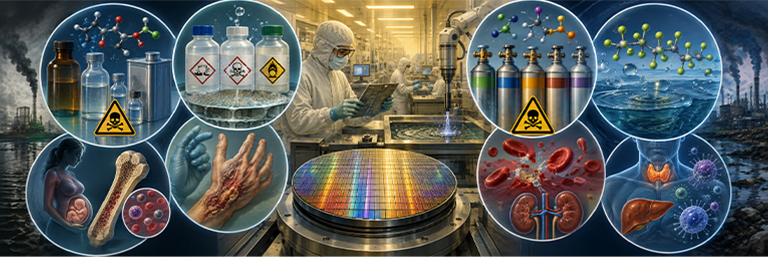
The Chemical Cocktails of Wafer Fabrication
Wafer fabrication relies on multi-step chemical processes to manipulate silicon substrates into integrated circuits. Key chemical classes include:
Solvents (Ethers, Ketones, Chlorinated Hydrocarbons): Glycol ethers (such as 2-methoxyethanol and 2-ethoxyethanol) are widely used in photolithography resist strippers and have been directly linked to reproductive toxicity, bone marrow suppression, and spontaneous abortion among female cleanroom operators. Chlorinated solvents like trichloroethylene (TCE) and carbon tetrachloride are documented renal and hepatic carcinogens.
Corrosives & Etchants: Hydrofluoric acid (HF), buffered oxide etchants (BOE), and nitric acid are utilized for wet etching. HF poses severe occupational systemic toxicity; dermal exposure to even small surface areas can cause fatal hypocalcemia and deep-tissue necrosis without immediate intra-arterial calcium gluconate intervention.
Toxic Gases & Dopants: Arsine (\text{AsH}_3), phosphine (\text{PH}_3), diborane (\text{B}_2\text{H}_6), and silicon tetrachloride (\text{SiCl}_4) serve as dopants and deposition gases. Arsine is a potent hemolytic agent capable of inducing acute intravascular hemolysis and renal failure at parts-per-billion concentrations.
PFAS (“Forever Chemicals”): Per- and polyfluoroalkyl substances are heavily utilized in anti-reflective coatings, surfactant formulations, and etching gases. PFAS persist indefinitely in environment matrices, bioaccumulating in human plasma and disrupting thyroid, hepatic, and immune functions.

Historical Lessons: Silicon Valley, Scotland, and South Korea
The narrative that high-tech manufacturing is a “clean, green industry” has been refuted by decades of international occupational health investigations:
Silicon Valley Superfund Sites (USA): Santa Clara County, California—the birthplace of the semiconductor industry—contains the highest concentration of EPA Superfund hazardous waste sites in the United States, largely resulting from leaking underground solvent storage tanks that contaminated municipal groundwater with TCE and 1,1,1-trichloroethane.
National Semiconductor Scotland (UK): A seminal 2001 investigation by the UK Health and Safety Executive (HSE) into the East Kilbride fabrication plant confirmed statistically significant elevations in breast cancer and digestive tract malignancies among female line workers exposed to complex chemical mixtures.
Samsung Electronics Occupational Leukemia Cluster (South Korea): Over a decade of litigation and independent toxicological auditing revealed clustered cases of acute myeloid leukemia, non-Hodgkin lymphoma, and rare cancers among young female technicians working in memory chip fabrication lines, leading to formal corporate apologies, worker compensation settlements, and mandatory safety overhauls.

Occupational Safety & Environmental Enforcement Gaps
While the Philippines maintains established environmental and labor protection laws, industrial capacity gaps pose enforcement challenges:
Regulatory Frameworks: Key legislation includes the Toxic Substances and Hazardous and Nuclear Wastes Control Act of 1990 (RA 6969), the Philippine Clean Water Act of 2004 (RA 9275), and the Occupational Safety and Health Standards Law of 2018 (RA 11058).
Institutional Capacity Gaps: The Department of Environment and Natural Resources – Environmental Management Bureau (DENR-EMB) and the Department of Labor and Employment (DOLE) face constraints in specialized equipment, specialized industrial toxicologists, and real-time monitoring infrastructure necessary to audit complex semiconductor supply chains.
Recommended Reform: Establish a specialized Inter-Agency Semiconductor Environmental Health & Safety (EHS) Oversight Task Force, equipped with independent analytical testing laboratories, real-time effluent monitoring capabilities, and mandatory workplace exposure tracking.

Occupational Safety & Environmental Enforcement Gaps
While the Philippines maintains established environmental and labor protection laws, industrial capacity gaps pose enforcement challenges:
Regulatory Frameworks: Key legislation includes the Toxic Substances and Hazardous and Nuclear Wastes Control Act of 1990 (RA 6969), the Philippine Clean Water Act of 2004 (RA 9275), and the Occupational Safety and Health Standards Law of 2018 (RA 11058).
Institutional Capacity Gaps: The Department of Environment and Natural Resources – Environmental Management Bureau (DENR-EMB) and the Department of Labor and Employment (DOLE) face constraints in specialized equipment, specialized industrial toxicologists, and real-time monitoring infrastructure necessary to audit complex semiconductor supply chains.
Recommended Reform: Establish a specialized Inter-Agency Semiconductor Environmental Health & Safety (EHS) Oversight Task Force, equipped with independent analytical testing laboratories, real-time effluent monitoring capabilities, and mandatory workplace exposure tracking.










Leave a Reply