

The Hidden Health and Financial Toll on the Sandwich Generation

Who takes care of the caregiver when everyone depends on them? They pay their children’s tuition while buying their parents’ medicines. They attend a school meeting in the morning, accompany an aging mother to the doctor in the afternoon, answer work messages in between, and lie awake at night calculating whether the family’s money will last until the next payday.
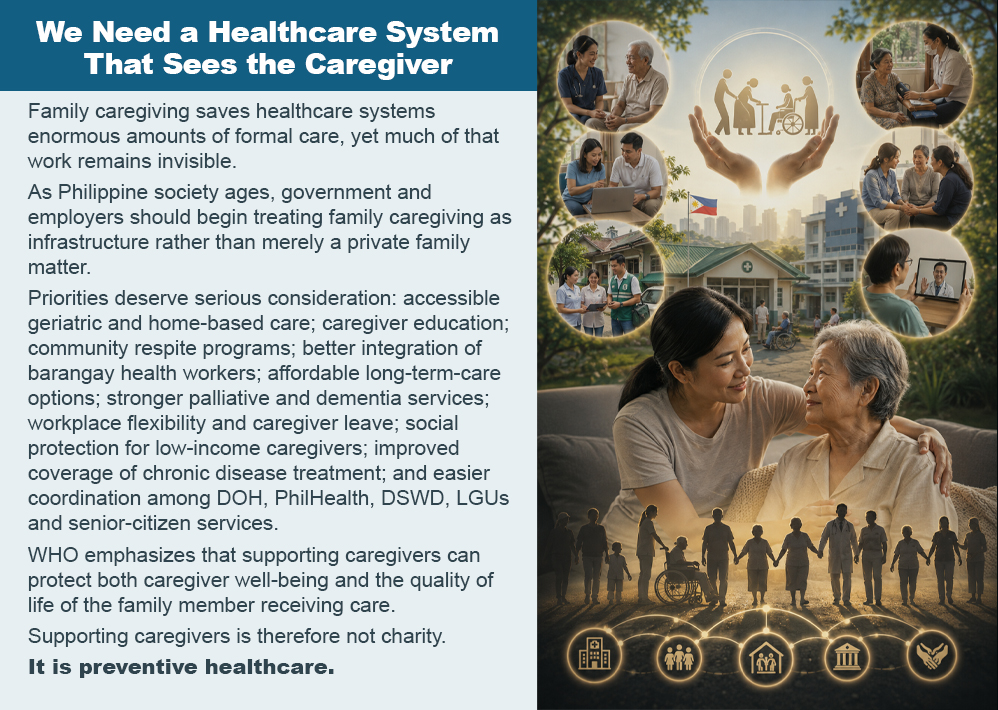
They are the sandwich generation—adults simultaneously supporting children and aging parents or other older relatives. In the Philippines, where family caregiving remains a deeply cherished responsibility, their sacrifices can easily be mistaken for limitless capacity. But chronic caregiving pressure can exact a price: anxiety, depression, sleep loss, neglected personal health, strained marriages, disrupted careers and financial insecurity.
Caring for two generations can be one of life’s greatest expressions of love. But love should not require the caregiver to become the family’s next patient.
“The sandwich generation is not being crushed by love. It is being squeezed by too many responsibilities competing for the same finite supply of time, energy and money.”
By Rafael R. Castillo, MD
The 5:30 A.M. Shift
Let us call her Maria. She is 48, married and employed. Before sunrise, she prepares breakfast and reminds her teenage daughter about an examination. Before leaving for work, she checks her 78-year-old mother’s blood pressure and arranges her medications.
At lunch, Maria receives a message: her mother feels dizzy. She rearranges meetings and accompanies her to the clinic.
That evening, her son needs money for a school project. Her mother’s laboratory tests need to be paid. The electricity bill is due.
Maria finally goes to bed after midnight. She is exhausted but cannot sleep.
Her own annual physical examination? She postponed it six months ago. There was simply too much to do.
Maria is hypothetical, but millions of middle-aged adults around the world would recognize her day. They occupy a peculiar stage of life: still parenting downward while increasingly caregiving upward.
Some are also supporting grandchildren, siblings or relatives with disability. Others are financing children who have already reached adulthood but remain economically dependent. And unlike a sandwich that can simply be put down, these responsibilities follow them everywhere.
Why This Matters in the Philippines
The Philippines remains relatively young, but it is aging. The 2020 census counted approximately 9.22 million Filipinos aged 60 or older—8.5% of the household population, up from 7.53 million or 7.5% in 2015. Meanwhile, about 30.7% of the household population was younger than 15. That demographic picture tells an important story. Between these two generations sits much of the working-age population.
Filipino culture traditionally regards caring for parents as an expression of utang na loob, gratitude and familial love. Multigenerational households can provide companionship and shared resources that many societies have lost.
Those are genuine strengths. But demographic change is altering the arithmetic. Parents are living longer. Chronic illnesses such as hypertension, diabetes, cardiovascular disease, cancer and dementia may require years of treatment. Medical technology can prolong life while simultaneously prolonging the period during which assistance is needed.
At the other end, children require education, food, housing, healthcare and—in an increasingly difficult economy—sometimes parental financial support well into adulthood. The middle generation may therefore be financing three futures simultaneously: their children’s, their parents’ and their own.
Something eventually gives. Too often, it is the third one.
The Mental-Health Squeeze
Caregiving is not inherently harmful. It can provide meaning, closeness, gratitude and a profound sense of purpose. But high-intensity caregiving without sufficient support can become psychologically exhausting.
WHO recognizes that prolonged care of a dependent older person can produce physical, emotional, social and financial stress. Research on unpaid caregiving likewise associates greater caregiving strain with depression and anxiety, with particularly heavy effects among people providing intensive care or living with limited economic resources.
The sandwich caregiver faces an additional complication: competing loyalties. Attend Father’s medical appointment—or the daughter’s graduation rehearsal? Use savings for Mother’s hospitalization—or the son’s college tuition? Work overtime to earn more—or leave early because a parent cannot safely remain alone?
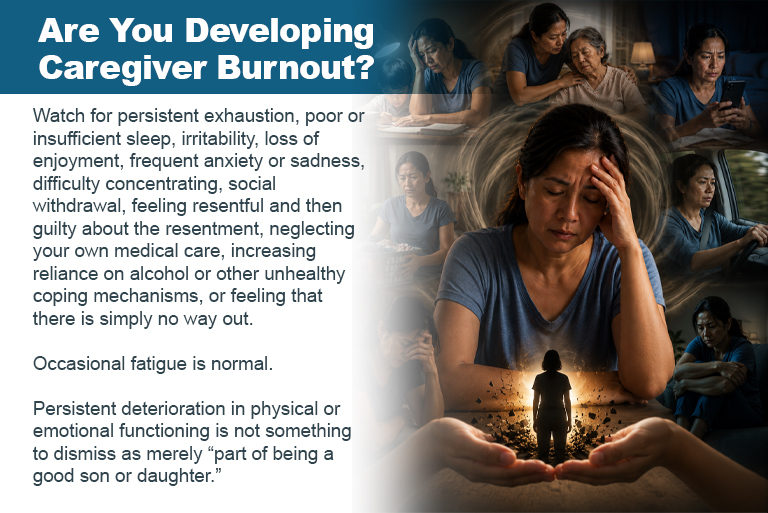
Every choice can produce guilt because saying yes to one loved one sometimes means saying no to another. Over time, chronic stress may appear as irritability, anxiety, sadness, difficulty concentrating, social withdrawal, emotional numbness or burnout. And because caregivers often tell themselves, “I have no right to complain; my parent is the one who is sick,” they may suppress their own distress.
When the Caregiver’s Body Pays the Bill
Stress is not confined to the mind. Heavy caregiving can interfere with sleep, exercise, healthy eating, preventive healthcare and medication adherence. Evidence on unpaid caregiving has associated high caregiving strain with poorer physical and mental health and adverse cardiometabolic outcomes.
Sleep deserves special attention. The caregiver may wake repeatedly because a parent needs assistance, then rise early to prepare children for school. Poor sleep itself is associated with hypertension, impaired glucose metabolism, obesity and cardiovascular risk.
Exercise disappears because there is “no time.” Meals become whatever is convenient. Medical appointments are postponed. The irony is striking: The person making sure everybody takes their medicines may forget to take his or her own.
Decades ago, an influential prospective study found substantially higher mortality among older spousal caregivers who experienced significant caregiving strain compared with noncaregiving controls. It should not be interpreted as meaning caregiving itself is deadly—the critical issue was caregiving accompanied by strain. That distinction remains important. We should not medicalize love. We should recognize overload.
The Financial Sandwich
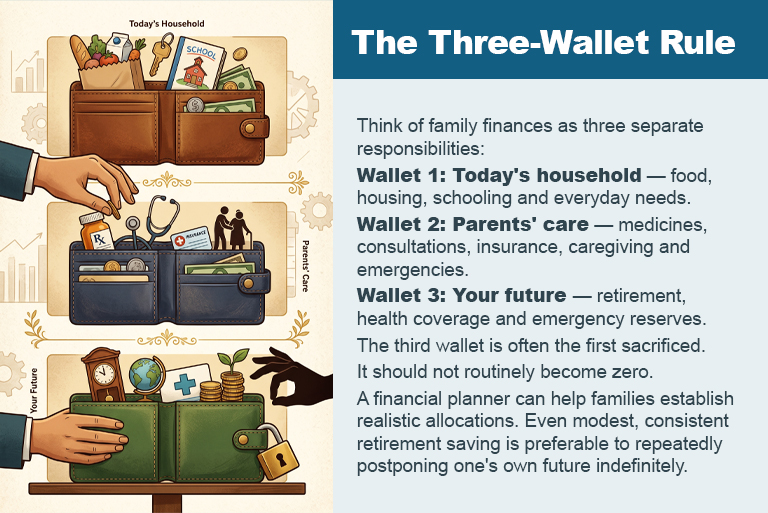
Then comes perhaps the most relentless pressure: Money. Imagine a household simultaneously paying for: school tuition; groceries; housing; children’s healthcare; parents’ medicines; laboratory tests; hospitalization; professional caregivers; and household help.
Now add retirement savings. Which expense gets postponed? Often, retirement.
Sandwich caregivers may draw down savings, borrow money, reduce working hours or decline career opportunities. Some leave employment altogether when an older parent requires constant supervision.
Financial insecurity itself can adversely affect health through chronic stress and barriers to healthcare and healthy living. And there is a cruel paradox. Sacrificing retirement savings to care for one’s parents today can leave the caregiver financially dependent upon his or her own children tomorrow.
Thus, without planning, the sandwich can reproduce itself across generations.
“Do not finance today’s caregiving crisis by creating tomorrow’s. Protecting some retirement savings is not selfish—it can spare your children from inheriting the same financial squeeze.”
The Marriage in the Middle
Caregiving can also enter the bedroom, dinner table and marriage. One spouse may feel that too much household income goes toward the other’s parents. Another may feel unsupported. Intimacy declines because everyone is exhausted. Arguments arise over siblings who contribute less.
Old family resentments resurface:
Why am I always the one taking Nanay to the doctor?
Why does Kuya contribute money but never time?
Why does our sister decide everything when I do the actual caregiving?
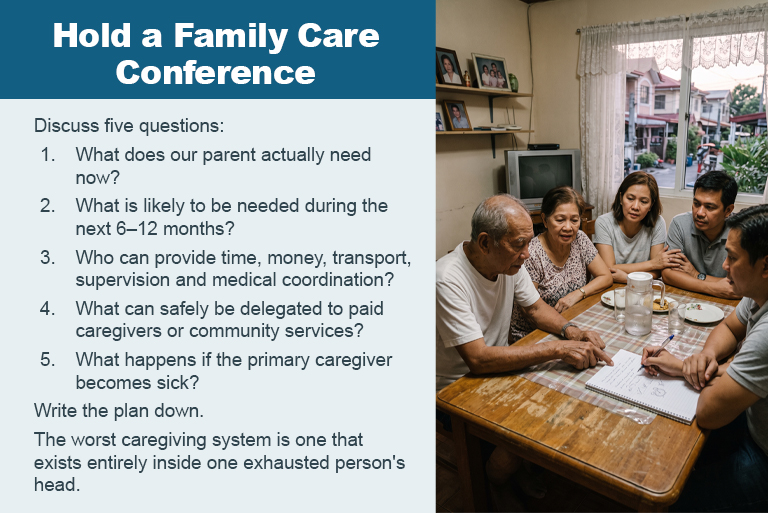
These conflicts are not evidence that a family lacks love. They often indicate that the care system lacks structure. Families should discuss responsibilities before a crisis rather than during one.
Stop Having One Family Hero
Perhaps the most practical rule is this: Caregiving should be a team sport.
One sibling may contribute money. Another can accompany a parent to consultations. Another handles medicines and appointments. A relative overseas may finance a professional caregiver. Teenage grandchildren can provide companionship and appropriate household assistance without being turned into substitute adults.
Fair does not always mean equal. It means responsibilities are transparent and proportionate to each person’s circumstances.
Self-Care Is Not Abandonment
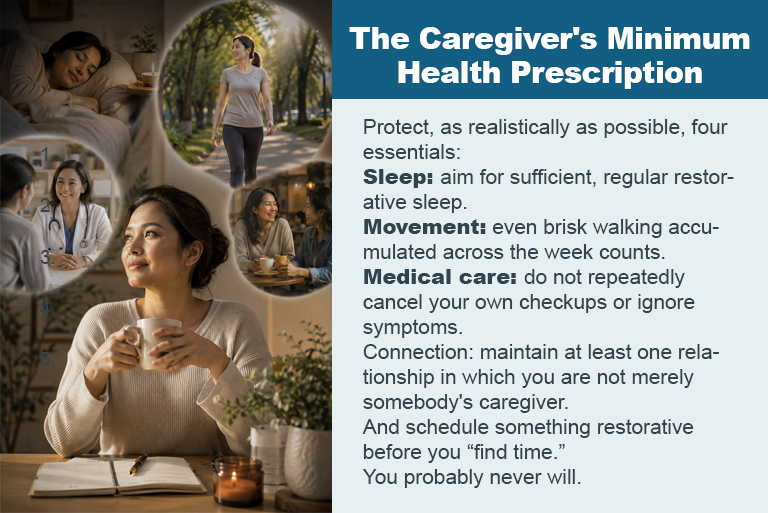
The phrase “self-care” can sound indulgent to someone choosing between an elderly parent’s medicines and a child’s school fees. So make it practical. Sleep. Exercise. Eat reasonably well. Keep your own medical appointments. Maintain friendships. Protect occasional time with your spouse. Accept help. Take breaks.
Research suggests caregiver interventions incorporating psychological skills, mindfulness and social support can improve some measures of depression, well-being and perceived support, although no single intervention works universally.
Respite is particularly important. Even several protected hours can allow a caregiver to exercise, attend church, meet friends, sleep or simply sit somewhere without being responsible for another human being.
Rest is not something caregivers must earn after reaching collapse. It is part of maintaining their ability to care.
Children Can Learn From Caregiving Too
The sandwich generation story need not be entirely negative. Children who witness parents lovingly caring for grandparents can learn compassion, patience, responsibility and respect for aging. But there is a boundary.
Children should participate in family care in age-appropriate ways—not become emotional confidants for adult financial problems or substitute caregivers whose schooling and childhood are sacrificed.
Healthy intergenerational caregiving teaches: We look after one another.
Unhealthy caregiving teaches: One person’s needs must disappear so everyone else can survive.
The first builds families. The second eventually breaks them.
When Professional Help Is Needed
Seek professional assessment when stress becomes persistent or begins impairing sleep, work, relationships or daily functioning.
Depression and anxiety are treatable. Likewise, caregiving demands themselves should be assessed. WHO’s guidance encourages health professionals to consider the caregiver’s physical and mental health, time burden, support system and opportunity for rest—not merely the condition of the older patient.
This suggests a simple improvement in clinical practice. When an elderly patient arrives accompanied by an exhausted son or daughter, perhaps physicians should occasionally ask a second patient-centered question:
“And how are you coping?”
REFERENCES
- Philippine Statistics Authority. Age and Sex Distribution in the Philippine Population: 2020 Census of Population and Housing. Quezon City: PSA; 2022. The census reported 9.22 million household residents aged ≥60 years, representing 8.5% of the household population.
- Philippine Statistics Authority. 2025 Philippine Statistical Yearbook. Quezon City: PSA; 2026.
- World Health Organization Regional Office for South-East Asia. Integrated Care for Older People (ICOPE): A Manual for Nurses. New Delhi: WHO SEARO. Sections on caregiver burden and caregiver support.
- Schulz R, Beach SR. Caregiving as a risk factor for mortality: The Caregiver Health Effects Study. JAMA. 1999;282(23):2215–2219. doi:10.1001/jama.282.23.2215.
- Kitko L, McIlvennan CK, Bidwell JT, et al. Family caregiving for individuals with heart failure: A scientific statement from the American Heart Association. Circulation. 2020;141:e864–e878. doi:10.1161/CIR.0000000000000768.
- Lam K, Tate CE. What role do medical professionals have supporting caregivers? JAMA Network Open. 2025;8(11):e2544321. doi:10.1001/jamanetworkopen.2025.44321.
- St-Onge MP, Aggarwal B, Fernandez-Mendoza J, et al. Multidimensional sleep health: Definitions and implications for cardiometabolic health: A scientific statement from the American Heart Association. Circ Cardiovasc Qual Outcomes. 2025;18:e000139. doi:10.1161/HCQ.0000000000000139.
- McLaughlin M, Albert MA. Financial insecurity and cardiometabolic health—a matter of survival. JAMA Cardiol. 2025;10(6):527–528. doi:10.1001/jamacardio.2025.0254.
- Lu X. Caught in the middle: depressive symptoms and life satisfaction of the sandwich generation in four-generation lineages in China. Humanit Soc Sci Commun. 2026;13:1315.
- Multicomponent intervention for distressed informal caregivers of people with dementia: a randomized clinical trial. JAMA Netw Open. 2025;8(3):e250069. doi:10.1001/jamanetworkopen.2025.0069.








Leave a Reply