

What the 2026 leptospirosis surge should teach every Filipino family — before the next storm

This year, more than 13,000 Filipinos caught leptospirosis — nearly half again as many as last year. Emergency rooms overflowed, dialysis machines ran around the clock, and hundreds of families lost someone to an illness that began, for many, as “trangkaso lang.” The monsoon has ended and the numbers are finally falling. But typhoon season isn’t over, and the habits that put people in hospital this year are still with us. Here is what we learned, and what every household should know before the water rises again.
By Rebecca L. Castillo, MD
A fever after the flood
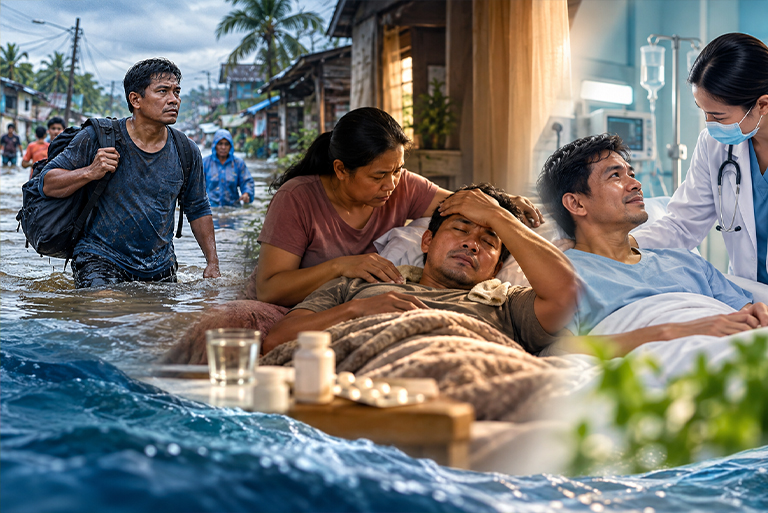
He is 34, a tricycle driver from Malabon. For two days in August, he kept working through knee-deep water because the passengers kept coming and the boundary still had to be paid. He had a small cut on his foot from a broken slipper strap. He thought nothing of it.
A week later, he had a fever. Then a headache that felt like a band around his skull. Then calf pain so bad he could hardly climb onto his tricycle. His wife bought paracetamol from the sari-sari store. “Trangkaso lang ito,” he told her.
By the time his eyes turned yellow and he had barely urinated in a day, he could no longer stand without help. At the hospital, the emergency room was so full that patients were being sorted in a tent outside. He needed dialysis within 24 hours.
He survived. Many didn’t.
I have changed the details, but the story is not invented in any sense that matters. Some version of it played out thousands of times across Metro Manila, Central Luzon and Calabarzon in the weeks after this year’s monsoon floods. Doctors at San Lazaro and the National Kidney and Transplant Institute told reporters the same thing again and again: most of their sickest patients came in late.
The numbers behind the headlines
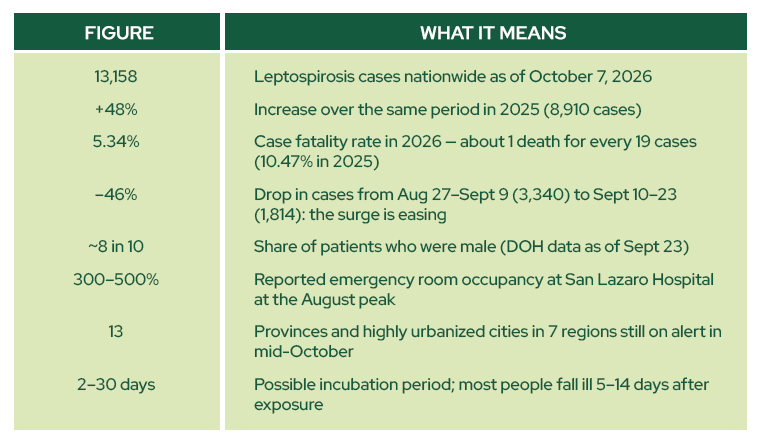
As of October 7, the Department of Health had recorded 13,158 leptospirosis cases for 2026. That is 48 percent higher than the 8,910 cases logged over the same period last year.
The surge came fast. Between August 9 and 22, cases more than quadrupled compared with the previous two weeks. At its peak, San Lazaro Hospital’s emergency room was reportedly running at three to five times its bed capacity. The hospital set aside 120 beds for leptospirosis alone, and they filled. A pediatric ward took in adults. NKTI temporarily limited walk-in admissions after its beds ran out.
Most patients were men — about eight in ten, according to DOH data released in September. That makes sense when you think about who wades through floodwater for a living: drivers, delivery riders, construction workers, vendors, barangay responders, the father who carries the children to higher ground.
There is some good news, and it deserves to be said plainly. The surge is easing. Cases dropped 46 percent between the two-week period ending September 9 and the one ending September 23. PAGASA declared the end of the southwest monsoon on October 5. And the case fatality rate this year, 5.34 percent, is roughly half of last year’s 10.47 percent.
Still, 5.34 percent means about one in every 19 people diagnosed has died. Behind that fraction are several hundred funerals, most of them for working-age adults.
What leptospirosis actually is
Leptospirosis is a bacterial infection. The bacteria, called Leptospira, live in the kidneys of infected animals and are passed out in their urine. Rats are the main culprit in our cities, but dogs, pigs, cattle and other animals can carry them too.
The bacteria survive for weeks in water and moist soil. When floods come, urine from thousands of rats in drainage canals, garbage heaps and sewers mixes into the water that flows through streets and homes.
People get infected when that water or mud touches broken skin — a cut, a scrape, an insect bite you scratched open, cracked heels. The bacteria can also enter through the eyes, nose and mouth. Skin that has soaked in water for a long time becomes softer and easier to breach. This is why the DOH has been careful to say that even people without visible wounds should get checked after wading.
It is not usually spread from person to person. You will not catch it from a sick family member by sharing a meal or a room.
How it shows up
The incubation period is typically 5 to 14 days but can range from 2 days to about a month. That gap is part of what makes leptospirosis dangerous. By the time the fever arrives, the flood is old news, and people don’t connect the two.
The early illness looks like a lot of things: sudden fever, chills, headache, body aches, nausea, vomiting. Two clues should make anyone suspicious, especially after flood exposure:
• Severe calf pain. Many patients describe it as the worst muscle ache of their lives.
• Red eyes without discharge. Doctors call it conjunctival suffusion. It looks like the eyes are bloodshot, but there is no pus or crusting like in sore eyes.
Most infections are mild and get better. But in a minority of patients, the disease turns severe — sometimes within days. The classic severe form, sometimes called Weil’s disease, attacks the kidneys, the liver and the blood vessels. Patients turn yellow. Their urine darkens or nearly stops. Some bleed.
The most feared complication is bleeding into the lungs. Patients cough up blood and struggle to breathe. It can kill within hours, even in a well-equipped ICU. Several of this year’s reported deaths followed exactly this course.
San Lazaro’s medical chief, Dr. David Suplico, noticed something unsettling this year: patients seemed to progress to severe disease faster than in past seasons, and younger people were among them.
The single most important thing: don’t wait
If there is one message I would want every reader to take from this issue, it is this: after wading through floodwater, a fever is leptospirosis until proven otherwise.
Treatment works best when it starts early. The DOH has told hospitals to begin antibiotics based on clinical suspicion alone, without waiting for a laboratory test to come back positive. Those tests take time, and in the early days of illness they can be falsely negative anyway.
The DOH also urges people to consult a health center or doctor after flood exposure even if they feel fine, so their risk can be assessed and preventive medicine given where appropriate. (More on that in our supplemental article on doxycycline.)
What doesn’t help is the Filipino habit of tiis — of enduring, of waiting to see, of treating every fever with paracetamol and a hope that it will pass by morning. That habit is understandable. A consultation costs money and a day’s wages. But this year, it cost lives.
Why this year was worse
Floods are nothing new to us. So why did 2026 bring nearly 50 percent more cases than 2025?
The honest answer is that we don’t know all the reasons yet. Part of it is the weather: weeks of torrential habagat rain on top of earlier storms left parts of Metro Manila and Central Luzon underwater repeatedly, and repeated exposure raises risk. Part of it may be better detection and reporting. Part of it is what was waiting in the water. Wherever garbage piles up and drainage fails, rats multiply, and every flood stirs up what they leave behind.
The lower death rate is also worth a careful look. Possible explanations include the DOH’s directive for “leptospirosis fast lanes” in public hospitals, wider use of preventive doxycycline, faster referral for dialysis, and the simple fact that a larger outbreak captures more mild cases. We should study it properly rather than claim easy credit.
This is not over
It would be a mistake to file leptospirosis away until next August.
The southwest monsoon has ended, but the typhoon season has not. Some of the most destructive storms in our recent memory arrived late in the year: Yolanda in November 2013, Ulysses in November 2020, Kristine in October 2024. Each brought floods. Each was followed by cases of leptospirosis.
We also know from the 2009 outbreak after Ondoy that a single catastrophic flood can fill hospital wards within two weeks. The DOH itself warns that a new wave of cases can follow about two weeks after any major flooding.
As of mid-October, 13 provinces and highly urbanized cities in seven regions were still on alert. Bicol, Eastern Visayas and the eastern seaboard, which tend to take the brunt of late-season typhoons, should be especially watchful.
What every household can do
Prevention isn’t complicated. It just has to be done, consistently, by everyone in the house.
• Stay out of floodwater whenever you can. If you must wade, keep it short.
• Wear protection. Rubber boots that reach above the waterline, waterproof gloves for clean-up. Plastic bags tied over the feet are better than nothing, but not by much.
• Cover every wound. Use waterproof bandages before going out; wash and disinfect any cut after.
• Wash right away. Soap and clean water on any skin that touched floodwater or mud, as soon as you can.
• Get checked within a day or two of exposure, even if you feel fine. Ask about preventive medicine.
• Don’t self-medicate the fever and wait. If you develop fever within a month of flood exposure, see a doctor and tell them about the flood.
• Fight the rats. Seal food, keep garbage covered, clear clutter around the house, and support barangay clean-up and declogging drives.
Beyond the household
Individual precautions matter, but they cannot carry the whole load. The tricycle driver in our story didn’t wade through floodwater because he was careless. He did it because his family needed to eat that day.
Leptospirosis is a disease of poverty and poor infrastructure as much as it is a disease of bacteria. It thrives where garbage collection is irregular, where drainage canals are clogged, where informal settlements sit on low ground, and where daily wage earners cannot afford to stay home when it floods.
That is why the long-term answer lies not only in our clinics but in our city halls and in the budget for flood control — a budget that, as recent investigations have reminded us, must actually produce working flood control.
A final word
Every year, the floods recede, the news moves on, and leptospirosis falls off the front pages. Then the rains return and we are surprised all over again.
This year, more than 13,000 Filipinos learned the hard way what a small cut and a few hours in floodwater can do. We owe it to them, and to the families who lost someone, to remember what we learned while it is still fresh. Wear the boots. Cover the wound. Get checked. And when the fever comes, don’t wait
“After wading through floodwater, a fever is leptospirosis until proven otherwise. Waiting to see if it passes is the most dangerous thing you can do.”
THE 2026 LEPTOSPIROSIS SURGE AT A GLANCE
Sources: Department of Health surveillance updates as reported by the Philippine Daily Inquirer (Oct. 13, 2026), The Philippine Star (Sept. 30, 2026) and GMA News (Aug. 2026).
KNOW YOUR RISK AFTER WADING
The DOH sorts flood exposure into three levels. Your level helps your doctor decide whether you need preventive medicine and for how long.
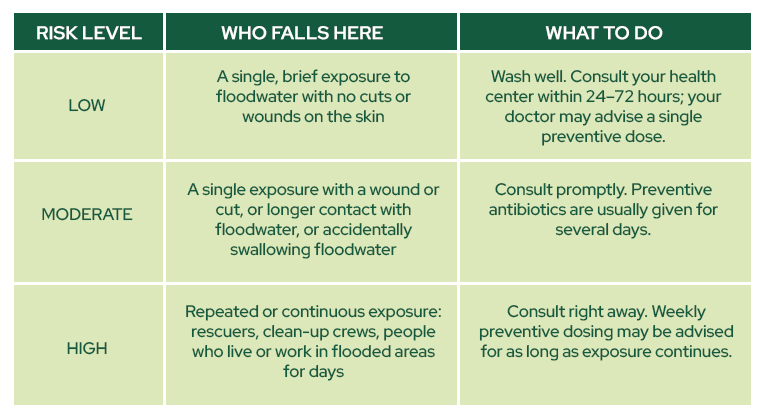
For clinicians: The Philippine Clinical Practice Guidelines on leptospirosis recommend doxycycline 200 mg as a single dose within 24–72 hours for low-risk adult exposure; 200 mg once daily for 3–5 days, started within 24–72 hours, for moderate risk; and 200 mg once weekly until the end of exposure for high risk. Doxycycline is generally avoided in pregnancy and in young children; consult current DOH guidance (including Department Memorandum No. 2026-0427) for alternatives and eligibility.
WARNING SIGNS THAT CANNOT WAIT
If you or a family member waded through floodwater in the past month, go to the emergency room immediately for any of the following:
• Yellowing of the eyes or skin
• Very little urine, very dark urine, or no urine for half a day or more
• Coughing up blood, or blood-streaked phlegm
• Difficulty breathing or chest tightness
• Unusual bleeding: from the gums, nose, or into the skin
• Confusion, extreme drowsiness, or a stiff neck
• Fever that persists beyond two to three days despite paracetamol, especially with severe calf pain or red eyes
Remember: Tell the doctor about your flood exposure, even if it was weeks ago. It changes how they think about your fever. For emergencies, call 911.
KEY REFERENCES
1. Department of Health. Leptospirosis surveillance update as of October 7, 2026, as reported in: Perez CC. “DOH: Leptospirosis cases show continuous decline.” Philippine Daily Inquirer, October 13, 2026.
2. Villanueva R. “DOH: Leptospirosis cases up, dengue down.” The Philippine Star, September 30, 2026.
3. Mangaluz J. “DOH: Wading through floodwaters can cause leptospirosis even without wounds.” GMA News Online, August 28, 2026.
4. GMA News. “Leptospirosis cases overwhelm hospitals amid widespread flooding.” GMA News Online, August 31, 2026.
5. Bonzo LT. “NKTI logs 5 leptospirosis deaths since June 1 amid habagat rains.” GMA News Online, August 21, 2026.
6. Daily Tribune. “DOH orders leptospirosis fast lanes in public hospitals.” August 6, 2026.
7. The Philippine Star. “PAGASA declares end of monsoon.” October 6, 2026.
8. Department of Health. Department Memorandum No. 2026-0427 on doxycycline prophylaxis for leptospirosis (2026).
9. Philippine Society for Microbiology and Infectious Diseases, Philippine Society of Nephrology, et al. Philippine Clinical Practice Guidelines on the Diagnosis, Management and Prevention of Leptospirosis in Adults. 2010.
10. World Health Organization and International Leptospirosis Society. Human Leptospirosis: Guidance for Diagnosis, Surveillance and Control. Geneva: WHO; 2003.
11. Costa F, Hagan JE, Calcagno J, et al. Global morbidity and mortality of leptospirosis: a systematic review. PLoS Negl Trop Dis. 2015;9(9):e0003898.
12. Haake DA, Levett PN. Leptospirosis in humans. Curr Top Microbiol Immunol. 2015;387:65–97.
13. Amilasan AT, Ujiie M, Suzuki M, et al. Outbreak of leptospirosis after flood, the Philippines, 2009. Emerg Infect Dis. 2012;18(1):91–94.
14. Brett-Major DM, Lipnick RJ. Antibiotic prophylaxis for leptospirosis. Cochrane Database Syst Rev. 2009;(3):CD007342.
15. US Centers for Disease Control and Prevention. Clinical overview of leptospirosis. Updated 2024.
16. The Philippine Star. “PhilHealth expands leptospirosis coverage.” July 7, 2026.
17. “Dengue cases top 192,000, leptospirosis cases rise nearly half as of Oct. 7.” BusinessWorld, October 13, 2026.
DOXYCYCLINE AFTER THE FLOOD
What the preventive pill can do, what it can’t, and why it is not a license to wade
By Rebecca L. Castillo, MD

Every flood season, one word starts circulating in barangay group chats: doxy.
People share photos of the capsules. Someone’s tita swears by it. A neighbor offers leftovers from last year’s supply. And many people treat it as a kind of shield, as if a pill in the pocket makes the floodwater safe.
It doesn’t. But used properly, it does help.
What it is
Doxycycline is an old, inexpensive antibiotic from the tetracycline family. It works against Leptospira, the bacteria that cause leptospirosis. When taken shortly after exposure, the idea is to stop the infection before it takes hold.
The DOH supports preventive doxycycline for eligible people exposed to floodwater, and in October it said it was replenishing supplies at rural health units and barangay health stations. The 2010 Philippine clinical practice guidelines describe how much to give and for how long, depending on whether a person’s exposure is low, moderate or high risk.
How strong is the evidence?
Here, honesty helps more than hype.
The studies on doxycycline prophylaxis are fewer and smaller than we would like. A Cochrane review found that the evidence was not strong enough to say firmly how well it prevents infection in every setting. Some studies showed fewer cases of clinical illness among those who took it; others were less conclusive.
Why recommend it, then? Because in a country where leptospirosis is common, floods are frequent, and severe disease can kill within days, the balance tips toward using it. The drug is cheap, generally safe for most adults, and short courses carry limited risk. Philippine guidelines and the DOH reflect that judgment.
What doxycycline is not is a guarantee. People who take it can still get sick. Which is why anyone who develops fever after flood exposure needs to see a doctor, pill or no pill.
Who should not just take it on their own
• Pregnant women and young children. Doxycycline is generally avoided in pregnancy and in young children. Doctors can recommend alternatives.
• People with allergies to tetracyclines.
• Anyone already feeling sick. If you have fever, prophylaxis is no longer the question. You need to be examined, and you may need treatment, not prevention.
A few practical points
• Take it with a full glass of water, sitting or standing, and don’t lie down for at least 30 minutes afterward. Doxycycline can irritate and even ulcerate the esophagus if it lodges there.
• Take it with food if it upsets your stomach, but avoid taking it together with milk, antacids, or iron and calcium supplements, which can reduce absorption.
• Use sun protection. Doxycycline can make skin more sensitive to sunlight.
• Don’t use last year’s leftovers or a neighbor’s tablets. Get assessed. The right course depends on your risk level.
The bigger danger: false security
The DOH has been clear on one point, and it bears repeating. Preventive doxycycline should not become a reason to wade through floodwater unnecessarily.
The best prevention is still the boring kind: stay out of the water when you can, wear boots, cover wounds, wash quickly, and get checked.
Bottom line: Doxycycline after flood exposure is a sensible precaution, not a force field. Get it from a health center or doctor, take it correctly, and see a doctor promptly if fever develops anyway.
NOT ONLY WHEN IT FLOODS
The everyday ways leptospirosis finds us — even on dry days
By the H&L Editorial Team

One of the patients profiled by GMA News at the National Kidney and Transplant Institute this August was a 71-year-old man who had needed dialysis for leptospirosis.
He had not waded through floodwater. He did not remember any wound. Doctors suspected rats in his house, which had once been used as a storeroom. The only possible entry point he could recall was an ingrown toenail.
His case is a useful reminder: floods drive the big outbreaks, but leptospirosis doesn’t need a typhoon.
Where else the bacteria wait
At home. Rats that nest in storerooms, ceilings, kitchens and under sinks leave urine on surfaces, in standing water, and on food left uncovered. Cleaning these areas barehanded, especially with cuts on the hands, carries risk.
In the fields. Rice farmers work for hours in flooded paddies where rats and farm animals live. Leptospirosis has long been an occupational disease in agricultural areas.
Around animals. Pigs, cattle, carabaos and dogs can carry and shed the bacteria. Backyard piggeries are common in many Filipino communities, and their runoff can contaminate nearby water.
In the canals and sewers. Garbage collectors, sanitation workers, street sweepers and those who clear drainage are exposed throughout the year.
On weekends. Swimming or wading in rivers, creeks and lakes after heavy rain, trail running through mud, and some adventure sports have all been linked to infections elsewhere in the world.
Simple protections for dry days
• Wear gloves when cleaning storerooms, garages and areas where rats have been. Wet down droppings with disinfectant before sweeping, so dust and droplets don’t fly.
• Keep food in sealed containers and never leave leftovers out overnight.
• Cover water storage drums and pails tightly.
• Fix gaps under doors and holes in walls and ceilings where rats come in.
• Have dogs vaccinated. Ask your veterinarian about leptospirosis vaccines.
• Farmers and animal handlers should wear boots and gloves when they can, and treat any cut seriously.
Remember: Fever with severe calf pain and red eyes deserves a doctor’s attention, whatever the weather — especially if there are rats where you live or work.
THE “WILD” DISEASES OF THE WET SEASON
Leptospirosis isn’t the only illness that follows the rain
By Reuben Ricallo

Every rainy season, the DOH reminds Filipinos to watch out for the “WILD” diseases. The acronym is easy to remember, and each letter carries its own lesson.
W — Water-borne diseases
When floodwater mixes with sewage and seeps into wells, pipes and water containers, diarrheal diseases follow: acute gastroenteritis, typhoid fever, cholera and hepatitis A.
What helps: Drink only safe water. When in doubt, bring water to a rolling boil for at least one minute, or use chlorine tablets as directed. Wash hands before eating and after using the toilet. Throw away food that has touched floodwater. Watch young children and older adults closely for signs of dehydration — sunken eyes, dry mouth, little urine, unusual drowsiness — and give oral rehydration solution early.
I — Influenza-like illness
Crowded evacuation centers, wet clothes and disrupted sleep make it easier for respiratory viruses to spread.
What helps: Cover coughs and sneezes. Wear a mask when sick and around vulnerable family members. Keep children home when they are ill. Seasonal flu vaccination is recommended especially for older adults, pregnant women, young children and people with chronic illnesses such as diabetes and heart disease.
L — Leptospirosis
Covered at length in this issue’s cover story. The short version: avoid floodwater, cover wounds, get checked after exposure, and never ignore a fever in the weeks after wading.
D — Dengue
Dengue cases this year have generally run below 2025 levels, but it has not gone away. More than 192,000 cases were reported nationwide as of early October, according to DOH figures cited by BusinessWorld, and recent weeks saw an uptick. Students were among the most affected.
Dengue mosquitoes breed in clean, standing water — the kind that collects in discarded tires, flower vases, roof gutters, plastic cups and water drums after the rains.
What helps: Follow the DOH’s “4S” strategy: Search and destroy breeding sites; use Self-protection such as repellents and long sleeves; Seek early consultation for fever; and Support fogging or spraying only in hotspot areas where cases are rising.
Danger signs of dengue: severe abdominal pain, persistent vomiting, bleeding from the gums or nose, black stools, restlessness or unusual drowsiness, and cold, clammy skin. These often appear as the fever is going down — exactly when families think the worst is over. Go to the hospital immediately.
Lepto or dengue? Both cause fever and body aches, and both can turn severe. Severe calf pain, red eyes and recent flood exposure point toward leptospirosis. Rash, pain behind the eyes and bleeding tendencies point toward dengue. But only a doctor can sort them out, and sometimes a patient has both. Avoid ibuprofen, mefenamic acid and aspirin for fever until a doctor has ruled out dengue; paracetamol is the safer choice.
WHEN THE KIDNEYS TAKE THE HIT
Why leptospirosis so often ends in dialysis — and what PhilHealth now covers
By the H&L Editorial Team
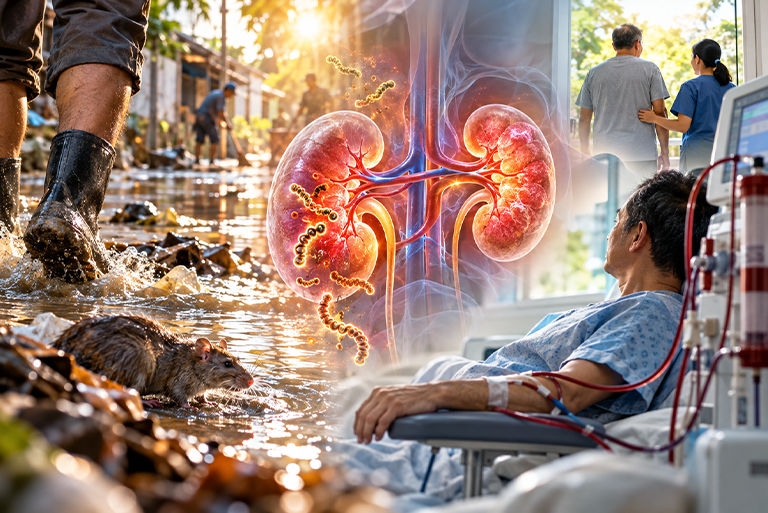
Talk to any nephrologist who worked through this year’s surge and you will hear about the dialysis chairs that never had a chance to cool down. At San Lazaro, six dialysis chairs reportedly ran 24 hours a day in late August.
Why the kidneys?
Leptospira bacteria have a particular fondness for the kidneys. In animals, that’s where they live and multiply. In humans, they can injure the tiny tubules that filter blood and make urine, while the infection’s effects on blood vessels and blood pressure reduce blood flow to the kidneys at the same time.
The result, in severe cases, is acute kidney injury. Urine output drops. Waste products and potassium build up in the blood. Fluid collects in the lungs. Without dialysis, some patients would not survive.
The good news about leptospirosis kidney injury
Unlike the kidney failure caused by long-standing diabetes or hypertension, kidney injury from leptospirosis is often reversible. With timely dialysis and treatment, many patients recover enough kidney function to stop dialysis within days to weeks.
That is why early referral matters so much. A patient who reaches a dialysis-capable hospital in time has a good chance of walking out with working kidneys. One who arrives too late may not.
Doctors also look for warning signs before the kidneys fail completely: decreasing urine, rising creatinine on blood tests, and abnormal potassium levels. These are reasons to refer early rather than wait.
What PhilHealth covers
In July, PhilHealth expanded its benefit package for leptospirosis, taking effect July 15, 2026. According to reports at the time, coverage includes:
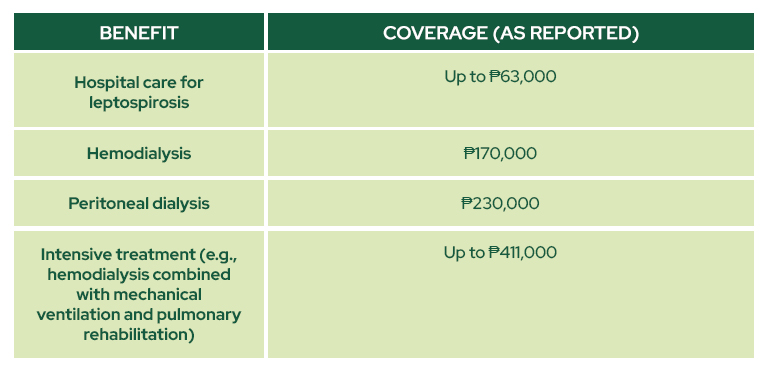
Benefit amounts as reported by The Philippine Star, July 7, 2026. Check current PhilHealth circulars and your hospital’s PhilHealth desk for eligibility and inclusions.
The DOH has also expanded zero-balance billing in a number of public hospitals, under which eligible patients pay nothing for hospital services, procedures, professional fees and medicines in basic accommodation.
Questions to ask the hospital
• Is this hospital accredited for the PhilHealth leptospirosis package?
• Which items are not covered?
• Does the hospital have a Malasakit Center or a social worker who can help with remaining costs?
• If dialysis is needed after discharge, where can it continue, and will it be covered?
After recovery: Patients who needed dialysis should have their kidney function rechecked after discharge, even if they feel well. Ask your doctor when to repeat your creatinine test.
PUBLIC HEALTH COMMENTARY
LEPTOSPIROSIS IS A DRAINAGE PROBLEM BEFORE IT IS A HOSPITAL PROBLEM
By the H&L Editorial Team
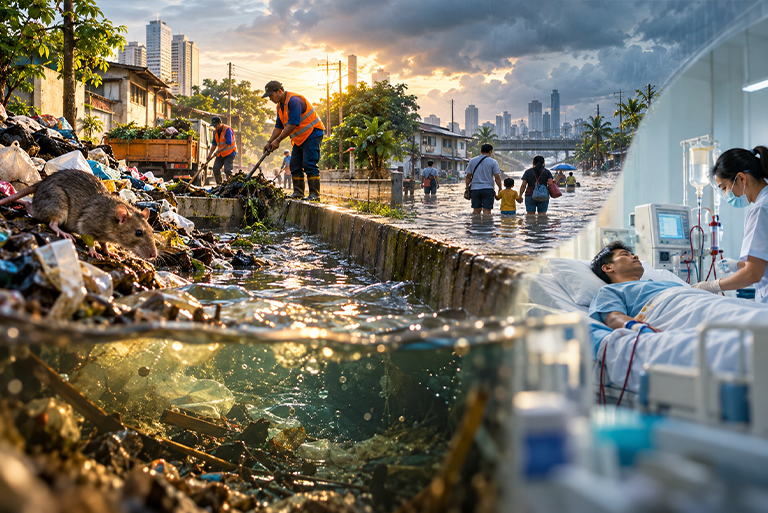
Every outbreak of leptospirosis ends in a hospital ward. But it doesn’t begin there.
It begins in a clogged canal that no one cleared before the rains. In a garbage pile that sat uncollected for a week. In a rat population that multiplied quietly through the dry months. In a flood-control project that existed on paper but not in the ground. In a family that lives on low land because it is the only land they can afford.
By the time a patient reaches San Lazaro with failing kidneys, the real failures have already happened, upstream and months earlier.
This doesn’t diminish what hospitals did this year. Doctors, nurses and dialysis staff worked impossible hours. The DOH’s fast lanes, prophylaxis drives and expanded PhilHealth coverage almost certainly saved lives. The halving of the case fatality rate is real, and those who worked for it deserve credit.
But a strategy that waits for people to get sick will always be playing catch-up. If we want fewer cases next year, the work has to happen now, during the dry months, when it is least urgent and most effective.
What would that look like?
• Declogging and drainage maintenance on a calendar, not in a panic. Canals should be cleared before the rainy season, not after the first flood.
• Consistent garbage collection, especially in dense urban communities. Rats follow garbage.
• Rodent control programs run by local governments, with clear targets and real monitoring.
• Pre-positioned boots, gloves and doxycycline in barangays that flood every year — before the water rises, not after.
• Occupational protection for the workers most exposed: street sweepers, garbage collectors, drainage crews, rescuers and farmers.
• Social protection that lets daily wage earners stay out of the water. A man who will lose a day’s food if he doesn’t drive cannot be expected to stay home.
• Flood control that works. Public money spent on flood control has to show up as less flooding. When it doesn’t, the bill is eventually paid in hospital wards and funerals.
None of this is glamorous. No ribbon-cutting. No dramatic rescue footage. But the most effective public health interventions rarely look like heroism. They look like maintenance.
The next flood is coming. The only question is whether the canals will be clear when it does.






Leave a Reply