

By Henrylito D. Tacio
“The purpose of life is not to be happy. It is to be useful, to be honorable, to be compassionate, to have it make some difference that you have lived and lived well.” ― Ralph Waldo Emerson
***
At eighteen thousand feet above sea level, where the air thins and every breath feels borrowed, a Filipino doctor stood at the edge of the world with a simple wish: that kindness shown to strangers would someday return to his people. In the vast whiteness of the Himalayas, where climbers chase glory, where avalanches erase dreams, and where cold can kill faster than time, Dr. Teofredo “Doc Ted” Esguerra carried not only medical kits and oxygen tanks. He carried the Filipino identity.
“This is my profession and a service I want to do as a Filipino doctor,” he said in 2006, when he served as flight surgeon for the Filipino team that scaled Mount Everest. “What was important is that they remember that a Filipino doctor treated them and treated them well. So, next time a Filipino passes through this area, I hope the locals will remember me and treat those Filipinos well too.”
It was a statement born not of pride, but of purpose. And it defined the man who would become one of the most respected wilderness and high‑altitude physicians in Asia.
Guardian of the Himalayas
For three months, Doc Ted lived among the Himalayan ranges, acclimatizing his body to the brutal altitude. “We climbed lower peaks to train and adapt to the environment,” he recalls. “Nobody just climbs the highest peaks there without acclimatizing.”
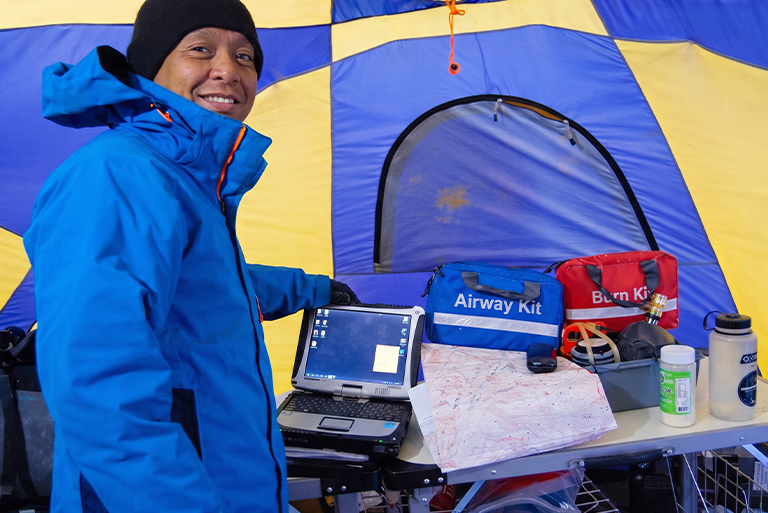
At Everest Base Camp, he became the lifeline of the Filipino expedition. But his responsibility extended far beyond his team. He oversaw nutrition, safety procedures, rescue protocols, and acclimatization training. He trekked and ran with climbers, checked their vital signs, and monitored their physiological responses to altitude. When someone’s body lagged behind the demands of thin air, he intervened with medication and close observation.
Soon, word spread across the mountain: there was a Filipino doctor who treated everyone for free.
In a place where medical consultations could cost US$75, Doc Ted became the most sought‑after figure in the camp. “Along the way, I ended up a doctor to everyone—Tibetans, Spanish, Italian, South African, Israeli, Belgian, Indonesian, Singaporean, Malaysian, American, French, German, Swiss, everyone!”
He was no longer just the Filipino team’s physician. He became the mountain’s doctor.
Rescuer in the Storm
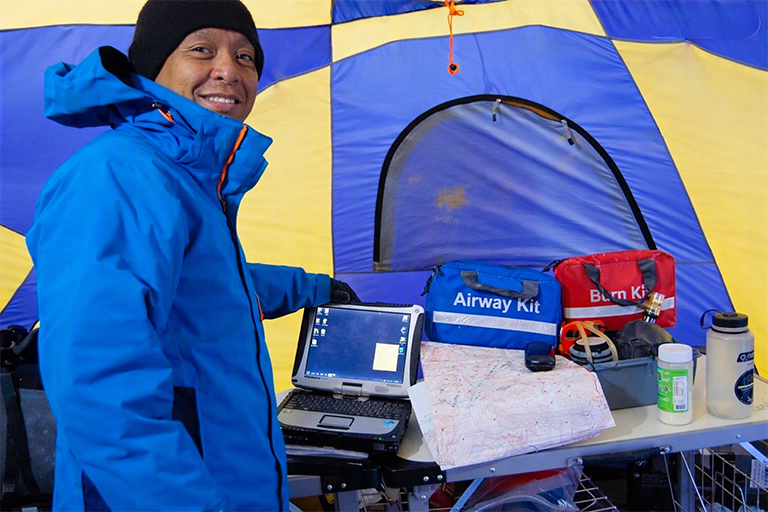
The Himalayas are beautiful, but they are also merciless. When storms roll in, they swallow climbers whole.
One day, two foreign climbers were trapped in heavy snowstorms buffeting Mt. Cho‑Oyu. Among them was Spanish climber Rafael Mician, who was suffering from pulmonary edema—a deadly condition where fluid fills the lungs, drowning a person from within.
Doc Ted joined the four‑hour rescue mission. In the chaos of snow and wind, he stabilized Mician and saved his life.
Other climbers would follow: Colombian mountaineer Camilo Lopez, Singaporean adventurer Khoo Swee Chiow, Malaysian climber Vincent Loh. But one case remained etched in his memory.
Indonesian trekker Amalia Yunita was suffering from cerebral edema—water in the brain. “This was an ICU case,” he says. “But she could not be brought down because she would die of the extreme cold.”
The Italian team at Lobuche had a laboratory known as the Pyramid. Despite Doc Ted being from another country, they opened their doors and allowed him to use their equipment. By the next day, Yunita had fully recovered.
Later, she wrote him a letter: because he saved her life, she had joined rescue missions herself. She had “paid it forward.”
A Doctor for Filipinos on the Summit
Doc Ted’s expertise was again called upon when three Filipinas attempted to climb Mount Everest the following year. One of them, Noelle Wenceslao, suffered from pulmonary edema. Team leader Art Valdez recalled how Doc Ted monitored her condition “every step of the way.”
In the Himalayas, where every heartbeat is a negotiation with altitude, Doc Ted became the quiet force behind Filipino triumphs.
The Making of a Wilderness Physician
Doc Ted’s life story before he became what he is now seems to be written for a movie script. He was left by his biological mother on the banks of Miral River in Bansalan, Davao del Sur and was adopted by the Esguerras.
While growing up, he dreamed of becoming a pilot. It so happened that his adoptive mother was stricken with cancer. He changed his plan and decided to take up medicine. He had his initial studies in Davao Medical School Foundation (from 1989 to 1991).
“But I was so active in the world of activism and music which cost me my studies,” he now recalled. He stopped for a year and concentrated on pursuing music and arts. “In those days, I was more of an artist. I sculpt, I paint, I perform in a band. I was noted as an artist more than as a doctor.
Then he had the chance to go back to school. He attended the Bicol Christian College of Medicine, where he finally graduated in 1994. He took his medical board examination in 1996.
His mantra of saving lives came because of a traumatic experience he had when he was a Grade 4 pupil of the Southern Mindanao Academy (now known as South Philippines Adventist College) in Matan-ao, Davao del Sur. He went swimming with some of his classmates after the morning class.
“I nearly drowned along the Managa River one noon,” he admitted. “Since then, I took the challenge on how to be skilled not to have an accident again – and how to save lives.”
His aviation medicine training came from an unlikely place: the Armed Forces Hospital Southern Region in Saudi Arabia. “I was an ambulance doctor there handling both ground and air,” he says. “I like flying. My childhood dream was to be a pilot.”
It was just a matter of time that Doc Ted became the founder and course designer of the volunteer national rescue team known as the Wilderness Search and Rescue (WISAR) Team. He is trained in Urban and Wilderness Rescue, Aviation Medicine, Expedition Medicine for Tropical and Alpine Mountain Operations, Tactical Medicine, and Disaster Management.
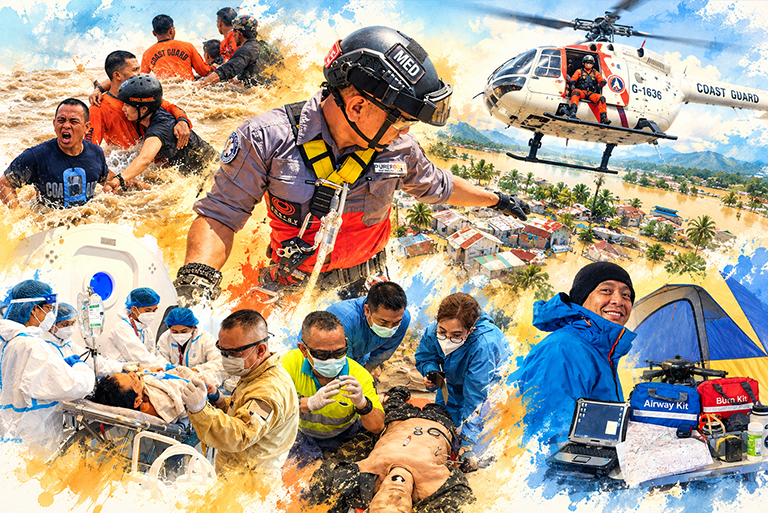
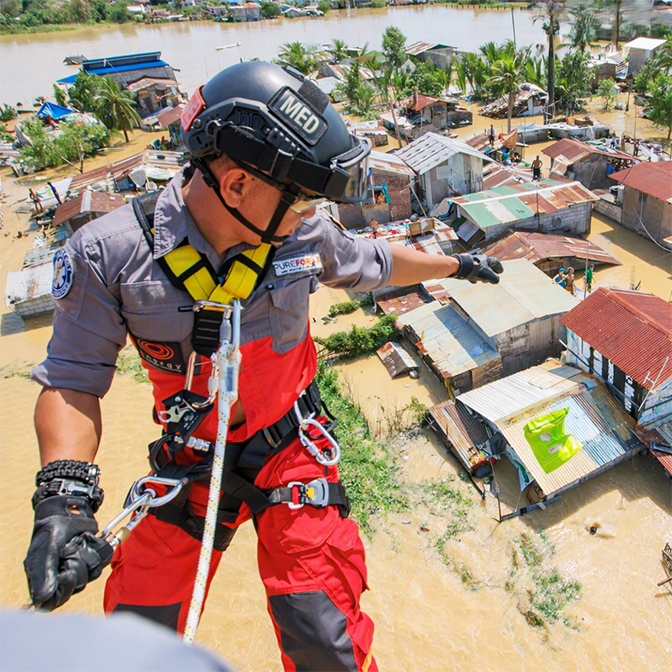
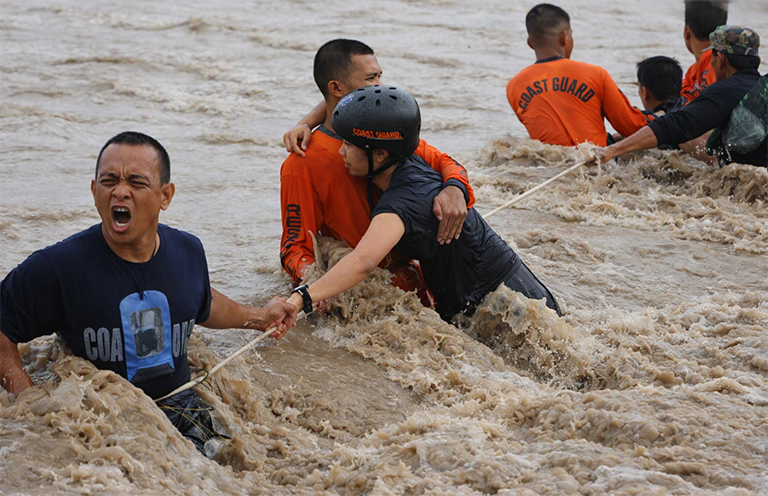
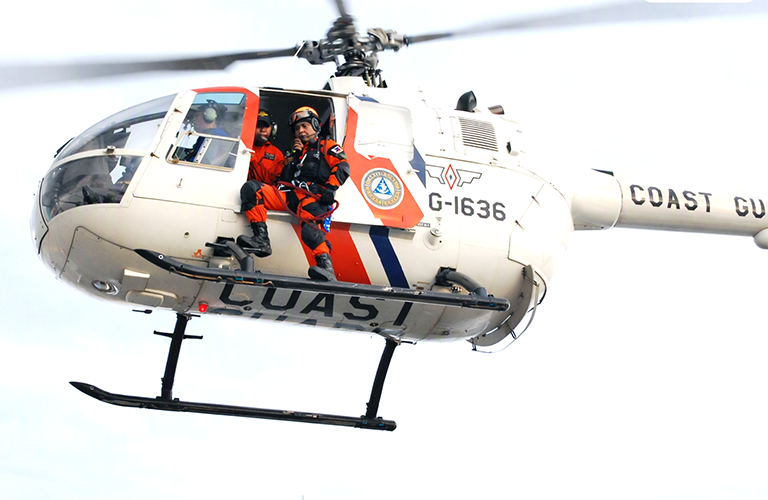
Doc Ted was also involved with the Philippine Coast Guard’s elite rescue team. He is sent with his crew to disaster zones, often rappelling down from helicopters to rescue sites. He takes his team through repeated training. The situations change, and include earthquake, hazardous materials, flood, bombing, combat and trauma. “We’ll make each day a safer one by training anyone how to save lives,” he said.
Hard core humanitarian worker
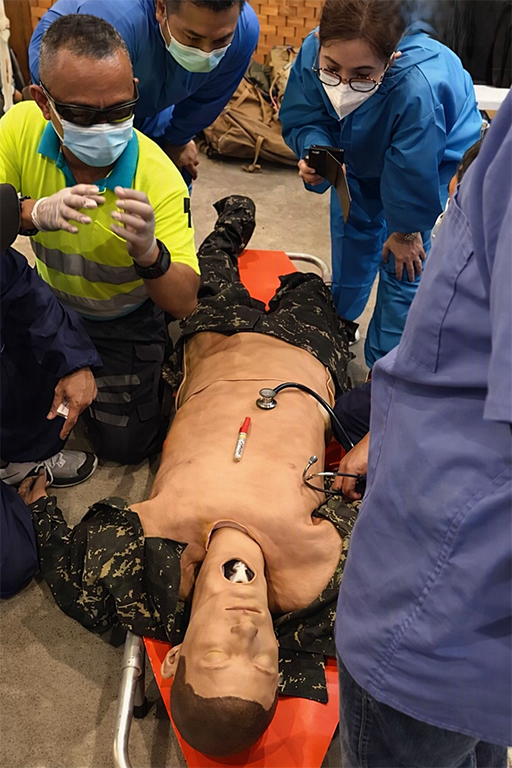
Today, Doc Ted is seen handling air medical evacuation, remote and wilderness rescue, and training responders across the country.
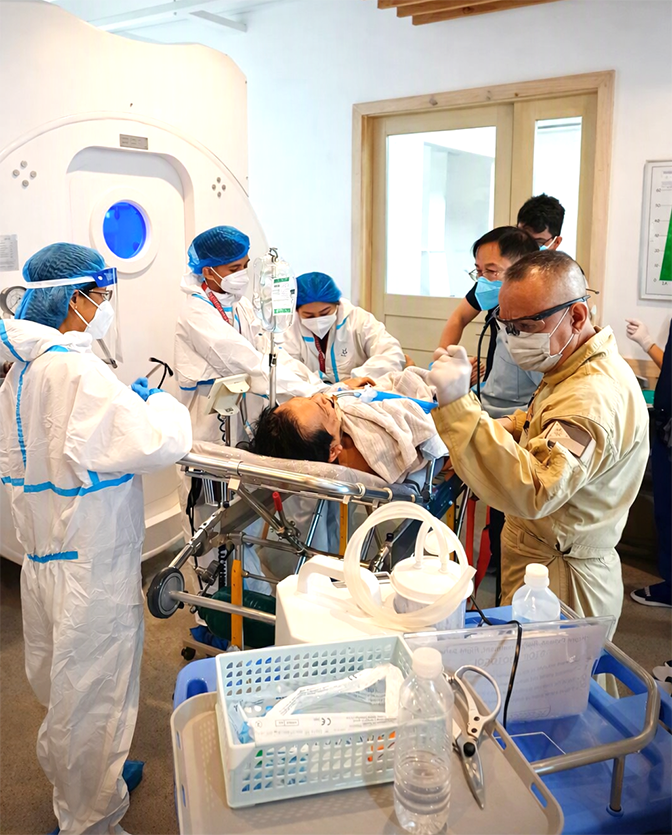
“I usually handle the difficult advance life support interventions,” he says. “Right now, I am busy teaching rescue and humanitarian operations to several local composite rescue teams. I found glory in that. We’ll make each day a safer one by training anyone how to save lives.”
He is not just a doctor. He is a teacher, a rescuer, a mentor.
He garnered extensive national and international recognition through prestigious awards and commendations, acknowledging his exceptional accomplishments in life preservation, advancement of humanitarian and pre-hospital medical services, environmental stewardship, and cultural and artistic conservation.
Unknown to many, Doc Ted considers himself “a hard core humanitarian worker.” He is connected with Knightsbridge International, a humanitarian organization known for operating in hostile areas around the world.
“I always render and facilitate humanitarian support locally and internationally,” he says.
His worldview is simple: politics and religion have no place in humanitarian work. “We just talk about how we can redeem the poor.”
He is also a member of Greenpeace Southeast Asia, reflecting his deep concern for the environment. If he were to be born again, he says he would choose to be a tribal chieftain—someone with the authority to protect nature, preserve culture, defend communities, and uphold the purity of science.
The Wounds That Never Healed
For all his achievements, Doc Ted carries a quiet sorrow. When he left home to pursue his career in Luzon, he rarely visited his parents. “The time I went home, they were already gone—not your way of saying goodbyes,” he says. “Worst is that I am a doctor and my parents died not in my arms. I could have extended some skills I have on them.”
It is a regret that follows him like a shadow. A man who saved countless lives could not save the two lives that mattered most.
The Poet in the Rescue Doctor
Beyond medicine and rescue, Doc Ted is also a songwriter and poet. In one of his poems, he wrote: “Saving life is my sole game, Careful teaching is my fame.”
It is a simple rhyme, but it captures the essence of the man: a healer who teaches, a rescuer who writes, a Filipino who carries his nation’s name with dignity wherever he goes.
From the rivers of Bansalan to the icy slopes of Everest, from air ambulances in Saudi Arabia to humanitarian missions across the world, Doc Ted Esguerra has lived a life defined by service.
He has saved strangers who became friends, trained rescuers who became heroes, and carried the Filipino identity to places where flags do not matter but kindness does.—###







Leave a Reply