


When I was a young doctor, there was not much we could do for a stroke.
We admitted the patient, kept the blood pressure in a safe range, prevented pneumonia and bedsores, and waited. We waited to see how much the brain would recover on its own. Families waited with us, usually at the bedside, sometimes praying the rosary in shifts. Often the answer, when it came, was not the one they hoped for.
I think of those years whenever I read about what stroke care can do today. A clot can now be dissolved with a single injection. It can be pulled out of a brain artery with a thin wire threaded up from the wrist. Scans can show which parts of the brain are dying and which can still be saved, even hours after the stroke began. A patient who arrives unable to speak can sometimes be talking to their family by evening.
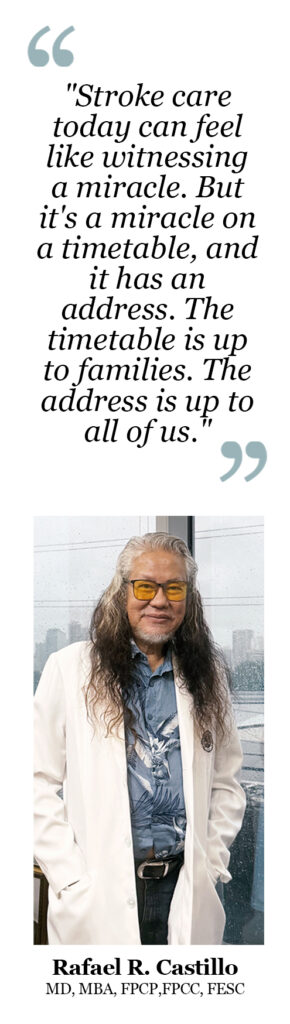
For someone who trained before all this, it still feels a little like witnessing a miracle.
But it’s a miracle on a timetable. And it has an address.
The timetable is the part we keep repeating, in May and again in this issue, because it is the part every family controls. These treatments work only when the patient arrives in time. Every minute at home — waiting for the symptoms to pass, waiting for the eldest son, waiting for permission — is a minute the brain does not get back.
The address is the part that troubles me more, because no family can fix it alone. This September, a regional report noted that Metro Manila, with its tens of millions of people, has only a handful of specialists who can remove a stroke clot. Most of that care is in private hospitals. PhilHealth does not yet pay for it. If a stroke strikes a farmer in Samar or a fisherman in Sulu, the miracle might as well not exist.
I don’t say this to discourage anyone. The new Philippine stroke guidelines, the simpler clot-busters, the hospitals slowly earning stroke-ready status — these are real steps, and the doctors and nurses behind them deserve our thanks. But medicine’s best achievements mean little until they reach the people who need them. That’s a job for policy-makers and hospital administrators, and also for all of us who vote, write and speak up.
Meanwhile, families can do what is within their power. Learn BE FAST. Know which hospital nearby can give clot-busting treatment, and which one it refers patients to for clot removal. Take your blood pressure medicine, every day. And when a stroke comes, don’t wait.
This week we also prepare for Undas. Many of us will stand before the graves of parents and grandparents who died of stroke, in years when little could be done. We can’t rewrite their stories. But we can make sure the next generation’s story is different — that when the miracle is possible, our families arrive in time to receive it.









Leave a Reply