

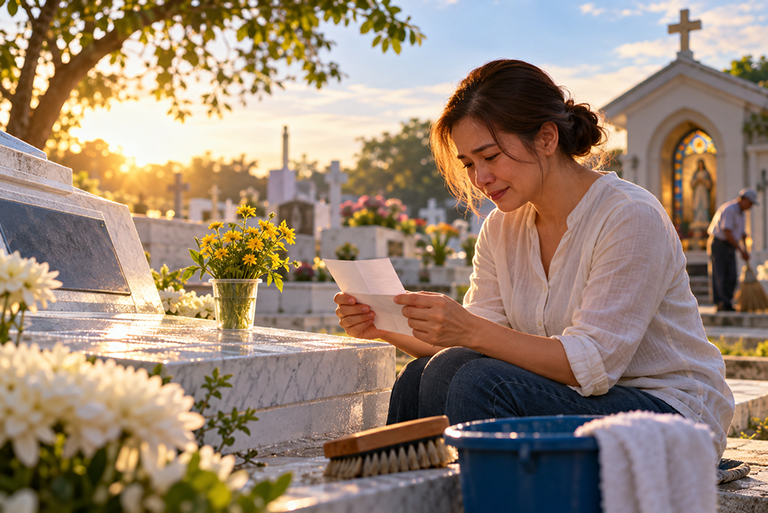
Every year we clean the graves of those we have lost, light candles, and bring flowers. But some of us tend the dead more faithfully than we tend the living. This Sabbath story, on the eve of All Saints’ Day, is about a woman, an estranged brother, and the discovery that the best way to honor our parents may be to make peace with the people they left behind.
“She had kept her mother’s grave spotless for three years. She had not spoken to her brother once in all that time.”
By Raffy Castillo
Teresa always went to the cemetery the Saturday before Undas.
She liked to go before the crowds came. Before the vendors set up their stalls of candles and flowers, before the families arrived with their folding tables and their pancit, before the place turned into something between a reunion and a fiesta.
She liked it quiet. Just her, a pail of water, a scrub brush, and her parents’ names on the marble.
For three years she had kept that tomb immaculate. Fresh paint every October. White chrysanthemums, her mother’s favorite. A small bottle of the cologne her father used to wear, dabbed on the stone. She was proud of it. The other tombs around it looked neglected by comparison.
The Brother She Didn’t Mention
What Teresa did not talk about, even to herself, was Ramon.
Her younger brother had stopped speaking to her a few months after their mother died. It was about the house in Malolos, of course. It was always about a house. He thought she had pressured their mother into changing the papers. She thought he had never helped when their mother was sick. Words were said at the 40th-day prayers that neither of them could take back.
Since then, nothing. He did not come to the cemetery when she did. She assumed he did not come at all.
Sometimes, scrubbing the marble, she would think: Mama would be proud of how well I keep this.
She never let herself finish the thought.
The Tomb Was Already Clean
This year, when Teresa arrived with her pail and her brush, she stopped short.
The tomb was already clean. Freshly painted. The weeds pulled. And on the marble, beside the space where she usually placed her chrysanthemums, was a small bunch of yellow santan in a plastic cup, the kind that grew wild in their old yard in Malolos.
Their mother used to pick santan for the little altar in the sala.
Teresa stood there for a long time.
Tucked under the cup was a folded piece of paper. She almost didn’t open it. When she did, she recognized the handwriting immediately — the same slanted letters from the notes he used to leave on the refrigerator when they were young.
“Ate, I come every year on Friday so I won’t run into you. I’m tired of hiding from my own sister at my mother’s grave. — R.”
What She Had Been Doing
She sat down on the low concrete ledge beside the tomb.
For three years, she realized, she had been taking care of the dead and avoiding the living. She had painted marble and arranged flowers and dabbed cologne on stone, and told herself it was love. And it was love. But it was also safe. Her parents could not disagree with her. They could not bring up the house. They could not say the things Ramon had said.
She thought of her mother in her last months, asking again and again, “Nag-usap na ba kayo ni Ramon?“
Teresa had always said, “Opo, Ma.” It had not been true.
The Verse in the Chapel
Before going home, she slipped into the small chapel at the edge of the cemetery. It was empty except for an old caretaker sweeping near the door. She sat in the back pew, and a verse she had memorized as a girl came back to her, unbidden: “If you are offering your gift at the altar and there remember that your brother has something against you, leave your gift there before the altar. First go and be reconciled to your brother, and then come and offer your gift.”
She had always thought of the altar as being in a church.
Now she thought of the marble tomb a few hundred steps away, and of all the gifts she had been carrying there — the paint, the chrysanthemums, the cologne — while the one gift her mother had asked for went undelivered.
The Phone Call
That afternoon, Teresa sat with her phone for almost an hour before she dialed.
He answered on the fourth ring. Neither of them spoke for a moment.
“I saw the santan,” she finally said.
Another silence. Then, quietly: “Mama liked those better than chrysanthemums, you know.”
She laughed, and it came out as half a sob. “I know. I just liked buying the chrysanthemums.”
They didn’t settle anything about the house that day. They didn’t go over who said what at the 40th day. But they agreed that tomorrow, on All Saints’ Day, they would go to the cemetery together, at the same time, for the first time in three years.
What She Wrote Before Sunset
That evening, Teresa wrote in the small notebook she kept by her bed.
“For three years I brought flowers to my mother. This year my brother brought them for both of us.”
And beneath it: “Maybe the best flowers for the dead are the ones we finally give the living.”
SABBATH REFLECTION
On the eve of All Saints’ Day, millions of Filipinos will travel home to remember those who have gone before. We will clean tombs, light candles, offer prayers and share food. These are beautiful traditions. They remind us that love does not end at the grave.
But the Sabbath invites a harder question. Is there someone living whom we have been avoiding, even as we faithfully honor the dead?
A sibling we stopped speaking to over an inheritance. A parent we visit only out of duty. A friend we wronged and never called. A child whose choices we could not accept.
The people we have lost cannot ask anything more of us. But the ones still here can. And often, the deepest way to honor our parents is to make peace with the family they left behind.
This Sabbath, before you light a candle for someone who has died, consider whether there is someone living who is waiting for a phone call.
CLOSING PRAYER
Lord of the living and the dead,
Thank You for those who have gone before us,
for the love they gave and the faith they passed on.
As we remember them this season, open our eyes to the living we have neglected.
Where pride has built walls, give us humility.
Where old words still wound, give us the grace to forgive and to ask forgiveness.
Teach us that the truest honor we can give our parents
is to love the family they left behind.
Let our reconciliations be the flowers we bring this year.
And bring us all, one day, to the communion of saints,
where no one is estranged and every tear is wiped away.
In Jesus’ name,
Amen.








Leave a Reply