

Surviving a stroke often raises a quiet but powerful question: Can I still be useful?
For many survivors with minimal residual deficits, the answer is a hopeful yes. With the right mindset, support, and pacing, life after stroke can include meaningful work, renewed purpose, and productivity—sometimes in ways even richer than before.
By Reuben Ricallo
A stroke can feel like an abrupt full stop—a moment when life is divided into before and after. For many survivors, especially those left with minimal residual deficits, the question that quietly follows recovery is deeply personal: Can I still be productive? Can I still work? Do I still matter?
The answer, increasingly supported by experience and evidence, is yes.
Recovery Is Not Just Physical—It’s Identity
Medical recovery often happens faster than emotional recovery. Even when speech is clear and movement has returned, confidence may lag behind. Many survivors underestimate themselves, fearing that employers—or even family—will see them as fragile.
Consider Ramon, 52, a logistics supervisor who returned home after a mild stroke with only slight hand weakness. Physically, he was cleared within months. Emotionally, it took longer. “I kept thinking, What if I fail? What if I slow everyone down?” he recalls. What changed was a simple decision: instead of returning full-time immediately, he negotiated a gradual return, starting with planning and coordination tasks. Within six months, Ramon was mentoring younger staff—and thriving.
Redefining Productivity
Post-stroke productivity does not always mean returning to the same job in the same way. It often means working smarter, not harder.
Liza, 45, previously ran a small retail store. After her stroke, long hours on her feet became exhausting. Rather than give up, she shifted her business online—managing orders, customer messages, and inventory from home. “I realized my brain still worked beautifully,” she says. “I just needed to listen to my body.”
Productivity after stroke may take the form of:
—Flexible or part-time work
—Remote or home-based roles
—Consulting, mentoring, or advisory positions
—Turning a lifelong skill into freelance work
What matters is contribution—not comparison to the past.
The Strengths Stroke Survivors Often Gain
Survivors frequently discover unexpected strengths:
—Sharper focus on what truly matters
—Greater empathy and patience
—Improved time management
—Stronger resilience and adaptability
Employers increasingly value these traits. Many survivors report becoming more intentional, less distracted, and more purpose-driven than before their stroke.
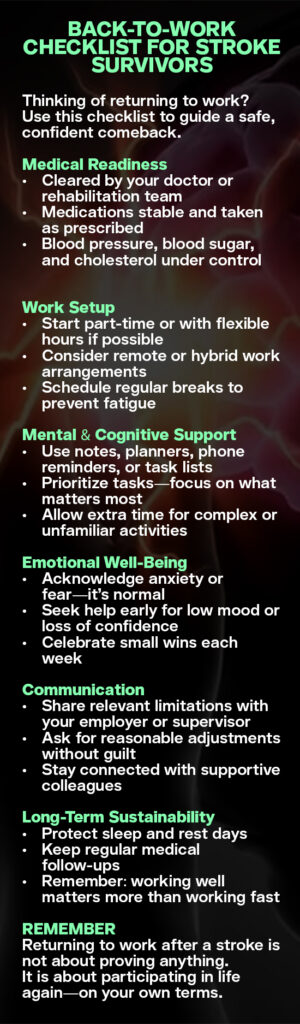
Practical Steps Back to Work
Successful return to work often follows a few key principles:
1. Start small and build up
A few hours a day can restore confidence without overwhelming the body.
2. Be open—but not apologetic
Sharing limitations helps set realistic expectations. A stroke is a medical event, not a personal failure.
3. Use supports wisely
Notes, reminders, calendars, and task lists are productivity tools—not signs of weakness.
4. Protect health first
Regular breaks, good sleep, and medical follow-up are part of the job description now.
Purpose Beyond Paychecks
Work is not only about income—it is about meaning. Some survivors find fulfillment in advocacy, volunteering, teaching, or creative pursuits.
Eduardo, 60, once a busy sales executive, chose not to return to corporate life. Instead, he began speaking to stroke support groups, sharing practical recovery tips. “I may not close deals anymore,” he says, “but I open doors for people who are scared.”
A New Chapter, Not a Smaller One
A stroke does not erase talent, intelligence, or worth. For survivors with minimal deficits, life after stroke can be deeply productive—sometimes even more aligned with purpose than before.
The path may be slower. The pauses more intentional. But productivity, dignity, and contribution remain fully possible.
Survival was the miracle.
Living meaningfully after—that is the mission.
“A stroke may slow the body, but it does not diminish talent, wisdom, or purpose.”