
By Reuben Ricallo
I have known Dr. Tony Leachon for many years.
Like many people who spend a lifetime in public service, he has his admirers and his critics. He can be outspoken. He can be relentless. At times, he can make people uncomfortable. But then again, some of the most important voices in public health often do.
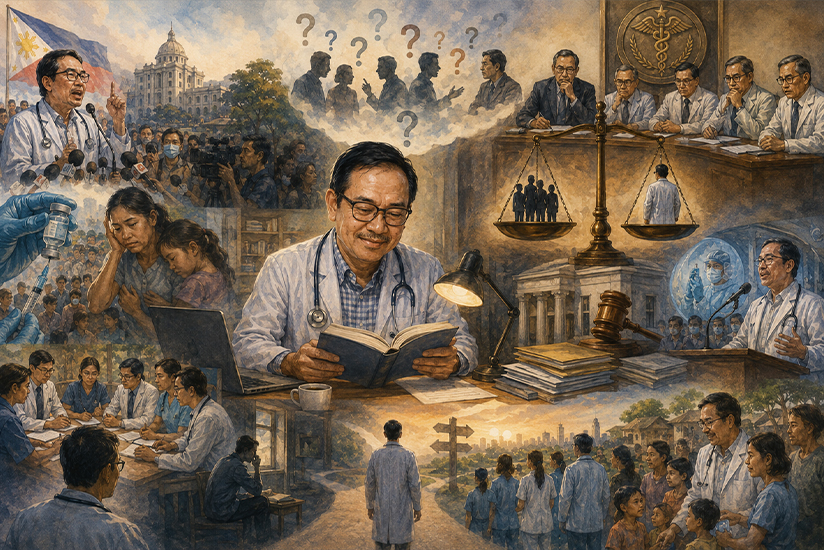
That is why the recent decision of the Philippine College of Physicians has given many physicians pause—not simply because it involves Tony Leachon, but because of the questions it raises for the rest of health advocates.
Every professional organization has the duty to uphold standards among its members. No one disputes that. But discipline carries weight only when members are confident that the process was fair, the penalty proportionate, and the circumstances fully appreciated.
Many of us are now asking questions.
Was the process sufficiently robust for a matter of this consequence?
Were all sides fully heard?
Was the sanction proportionate to the findings?
And what message does this send to physicians who choose to participate in public debates involving controversial health issues?
These are not questions about personalities. They are questions about the profession we belong to.
Medicine does not end at the clinic door.
Throughout many physicians’ careers, there are encouraged to educate the public, engage policymakers, challenge bad science, expose harmful practices, and speak when public welfare is at stake. We ask doctors to use their expertise not only for individual patients but also for society.
That responsibility is not always comfortable.
It sometimes requires disagreeing with powerful people. It sometimes requires taking unpopular positions. It sometimes places physicians in the middle of contentious public debates.
The Dengvaxia controversy was one such moment.
Reasonable people may differ on what happened, who was right, or who was wrong. The courts will continue to examine many of those questions. But it is difficult to deny that it was one of the most consequential public health controversies in recent Philippine history.
Many physicians spoke out.
Tony Leachon was one of them.
Whether one agreed with him or not, he participated in a national conversation that had profound implications for public trust in health institutions, vaccination programs, and government accountability.
That is why many physicians are uneasy now.
Not necessarily because we believe Dr. Leachon is beyond criticism. No physician is.
Rather, because we are trying to understand where vigorous public advocacy ends and professional misconduct begins.
That line matters.
If it becomes unclear, some doctors may simply choose silence over engagement. They may decide that speaking publicly on controversial issues carries risks that are not worth taking.
That would be a loss not only for the profession but for the public we serve.
I am not writing this to challenge the authority of the PCP. Nor am I suggesting that institutions should be immune from difficult decisions. Institutions matter. Standards matter. Accountability matters.
But so do fairness, proportionality, and independence.
Trust in any institution comes not only from the decisions it makes but from confidence in how those decisions are reached.
At the end of the day, this discussion is larger than Dr. Leachon.
Long after this controversy passes, the medical profession will still need physicians willing to speak honestly about difficult public health issues. We will still need institutions capable of enforcing standards while protecting the independence of their members. And we will still need the public’s trust.
Those goals should not be in conflict.
I do not know whether everyone will agree on the merits of this case.
What I do know is that many thoughtful physicians are asking important questions.
Those questions deserve to be heard.
And for the good of the profession, they deserve thoughtful answers.








Leave a Reply