

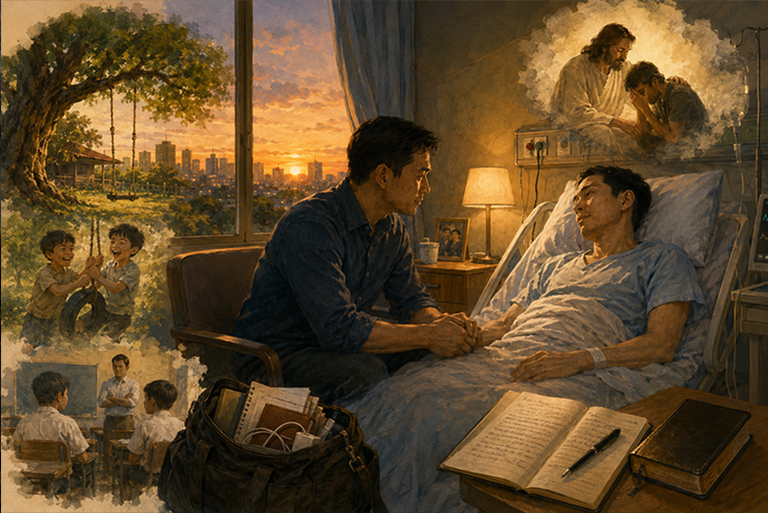
We often believe that love is measured by what it can fix. We search for the right words, the right medicine, the right solution. Yet some burdens cannot be removed, only shared. This Sabbath story is about a man who discovered that presence may be one of the holiest gifts we can offer—and one of the hardest to receive.
“He came hoping to make things better. Instead, he learned the grace of simply staying.”
By Raffy Castillo
David had always known what to do. When a pipe leaked, he found a wrench. When an account was short, he revised the budget. When someone asked for advice, he arranged the facts into neat columns and offered a plan.
People trusted him because he was practical.
He did not panic easily. He believed most problems became smaller once they were named, measured, and given a deadline.
But on a Friday afternoon, as the sun began its slow descent, David received a message he did not know how to answer.
His older brother, Samuel, had been admitted to the hospital again. The treatment was no longer working as well as the doctors had hoped.
Samuel’s wife wrote only:
“He has been asking for you.”
David stared at the message. Then he began gathering things. A phone charger. A notebook. A list of questions for the doctors. Articles he had saved about new treatments. The name of a specialist recommended by a colleague.
By the time he left the house, he carried a bag filled with possible answers.
The Room Where Answers Grew Smaller
Samuel was awake when David arrived. The hospital room was dim except for a lamp near the bed. Outside the window, buildings stood against the last amber light of Friday.
“You came,” Samuel said.
“Of course.”
David placed the bag on the chair and began unpacking.
“I wrote down a few things we should ask tomorrow. There may be another opinion worth getting. I also read about a treatment being studied abroad. It may not apply, but we should at least—”
Samuel closed his eyes. Not impatiently. Only wearily. David stopped.
After a moment, Samuel said, “Can you sit down first?”
David looked at the papers in his hand. Then at the empty chair beside the bed. He sat.
The Things Samuel Did Not Ask
For several minutes, neither brother spoke.
David found the silence unbearable. He wanted to explain the articles. He wanted to discuss laboratory results. He wanted to turn fear into a problem that could be managed.
But Samuel did not ask about treatments. Instead, he asked whether the old mango tree still stood behind their childhood home.
“Yes,” David said. “It leans farther toward the road now.”
Samuel smiled. “Do you remember the swing?”
“The rope always twisted.”
“You blamed me.”
“It was your fault.”
They laughed quietly.
Then Samuel asked about David’s children. About their mother’s old recipe for soup. About a teacher they had both feared in primary school. Nothing important, David thought at first.
And then he realized these were perhaps the most important things Samuel could speak about.
They were pieces of a life he wanted someone else to remember with him.
The Sabbath Arrived Quietly
The final light disappeared from the window.
Somewhere beyond the hospital walls, families were lighting candles, preparing meals, closing shops, and welcoming the Sabbath.
Inside the room, a nurse adjusted Samuel’s medication and left. David glanced at his watch. He had planned to attend worship the following morning. He had brought his Bible and imagined reading a psalm beside the bed before returning home.
Samuel shifted beneath the blanket.
“You don’t need to stay all night,” he said.
David looked at the chair. It was narrow and stiff, designed for brief visits rather than long vigils.
“I know,” he replied. But he did not stand.
The Ministry of Remaining
As the hours passed, David began to understand how deeply he had confused usefulness with love.
He had always shown care by doing. Driving. Paying. Organizing. Advising. Repairing. But now there was nothing he could repair. No sentence could make the diagnosis disappear. No plan could guarantee another year.
The limits of his competence felt almost like failure.
Then Samuel reached toward the edge of the bed. David took his hand. No words were exchanged.
The room remained unchanged. The illness had not retreated. The uncertainty had not lifted. Yet something had been given.
Samuel was no longer alone. And perhaps, David thought, neither was he.
What Jesus Had Often Done
Near midnight, Samuel fell asleep.
David opened his Bible, but instead of reading where he had planned, he found himself thinking about the many moments in Scripture when Jesus simply entered another person’s sorrow.
He sat beside the grieving. He wept at a tomb. He stayed with frightened friends. He did not always begin with an explanation. Sometimes He began with presence.
David had spent years asking God to show him what to do.
That Sabbath night, the answer seemed to be:
Stay.
Not because staying would change the outcome. Because love does not abandon a person merely because it cannot control what happens next.
The Longest Night
The chair became more uncomfortable as the night deepened.
David’s back ached.
The corridor lights never fully dimmed. Machines sounded at irregular intervals. Nurses entered and left.
At one point, Samuel woke and saw him still seated there.
“You stayed.”
David smiled.
“Yes.”
Samuel nodded, then closed his eyes again.
It was only two words. But David heard within them something larger than gratitude. He heard relief.
The Morning Light
At dawn, pale light entered the room.
David had not slept much. He looked tired, his shirt creased, his carefully prepared questions still untouched inside the bag.
Samuel opened his eyes. For a while, they watched the morning gather beyond the window.
Then Samuel whispered, “This is a good Sabbath.”
David looked around the hospital room. Nothing about it resembled the Sabbath mornings he knew. There was no familiar sanctuary. No choir. No quiet breakfast at home.
Only two brothers, a hospital bed, and a chair that had held one of them through the night.
“Yes,” David said. “It is.”
What He Wrote Before Sunset
That afternoon, while Samuel slept again, David opened his notebook.
The pages were filled with medical questions, telephone numbers, and unfinished plans.
On a blank page, he wrote:
“I thought love meant finding a way out. Today, I learned that sometimes love is refusing to leave.”
He placed the notebook inside the bag. The answers might still matter. The questions would eventually need to be asked.
But for now, David returned to the chair beside the bed. He sat without speaking. And for the first time, he did not feel useless.
He felt present.
Sabbath Reflection
We live in a world that values solutions.
We admire the person who knows what to say, what to prescribe, what to repair, and what to do next.
But life eventually brings us into rooms where our answers become small.
A loved one is ill.
A friend is grieving.
A child is frightened.
A marriage is wounded.
A prayer remains unanswered.
In such moments, we may feel helpless because we cannot remove the pain.
Yet the Sabbath reveals another kind of faithfulness.
God does not love us only by changing our circumstances. He also loves us by remaining with us within them.
The Sabbath itself is an act of divine presence. It comes each week not necessarily to solve everything, but to remind us that we do not face anything alone.
This Sabbath, perhaps someone near you does not need another explanation.
Perhaps they need a chair pulled closer.
A hand held quietly.
A meal shared without hurry.
A listening heart.
The willingness to remain after all useful words have ended.
Presence may appear modest beside dramatic solutions.
But to the lonely, the frightened, and the suffering, it can feel like grace made visible.
Sometimes the holiest thing we can say is not a sentence.
It is simply:
“I am here. I am staying.”
Closing Prayer
Heavenly Father,
I often want to repair what is broken and remove the pain of those I love.
When I cannot, I feel helpless and afraid.
Teach me that love is not measured only by the problems I solve.
Give me the courage to enter another person’s sorrow without rushing to explain it.
Help me listen without impatience, sit without discomfort, and remain without demanding that the moment become easier.
Thank You for being the God who stays with us through the long nights, the uncertain diagnoses, the unanswered questions, and the silent rooms.
May my presence become a quiet reflection of Yours.
And when I am the one who is weak, teach me the humility to receive the love of those who pull a chair beside me and stay.
In Jesus’ name,
Amen.









Leave a Reply