

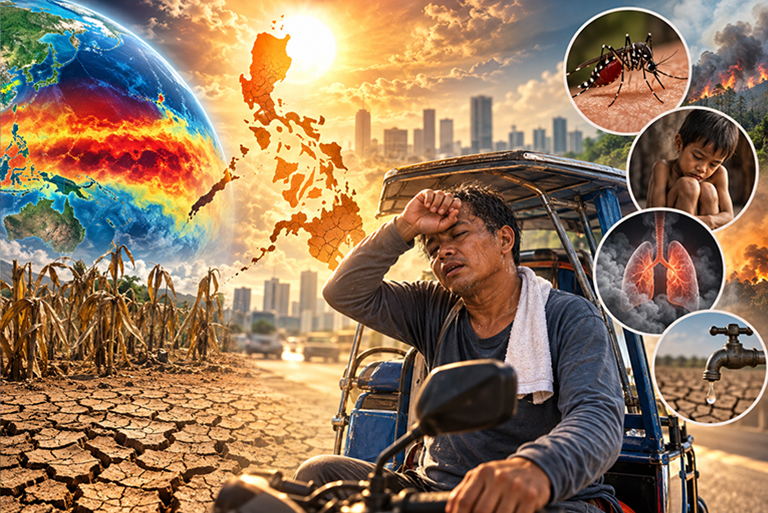
As shifting global climate cycles threaten prolonged heatwaves and severe moisture depletion, the Philippines faces more than just agricultural and economic strain. Award-winning environmental journalist Henrylito D. Tacio explores how intense climate phenomena endanger human health—from cardiovascular collapse on sun-scorched streets to the compounding threats of vector-borne disease and malnutrition.
Words and Photos by Henrylito D. Tacio
Science sounded the alarm early in the year. Meteorologists warned that the Pacific was warming, that the ocean‑atmosphere system was shifting, and that a strong El Niño was imminent. Yet intermittent rains lulled many into complacency, as warnings were drowned out by the sound of rainfall on tin roofs.
Now, the country faces a climatic reckoning.
For 45‑year‑old tricycle driver Rogelio, the reckoning arrived quietly through his own body. One afternoon in late July, he felt dizzy while waiting for passengers along a sun‑blasted highway. Heat shimmered off the asphalt like a living thing. Sweat poured down his back, then suddenly stopped.
His vision blurred. By the time a bystander rushed him to a nearby clinic, Rogelio’s blood pressure had spiked dangerously, his kidneys were struggling under acute distress, and he was slipping into heatstroke.
“I thought it was just the usual init,” he later recalled. “But this one felt different. Parang niluluto ang katawan ko.”
Doctors confirmed the stark reality: the heat was no longer normal. It was El Niño heat—relentless, punishing, and medically dangerous.
A Mirror From the Past
It is not only public health that hangs in the balance; food production faces equal peril. The Bible offers a haunting parallel in Genesis 41, where Pharaoh dreams of seven robust cows devoured by seven emaciated ones, and seven healthy ears of grain swallowed by seven withered stalks. None of Egypt’s wise men could interpret the vision until Joseph stepped forward.
Joseph foretold seven years of abundance followed by seven years of severe drought. Acting on this prophecy, he stored grain “as plentiful as the sand by the sea,” preparing Egypt for the hardship ahead. When the drought arrived, Egypt survived because it heeded the warning.
Today’s climate disruptions may not follow a seven‑year cycle, but the core lesson endures: heed the warning or suffer the consequences.
The Threat of a Super El Niño
“Our forecasts show an exceptionally high likelihood that elevated ocean temperatures will drive stronger weather extremes globally,” scientists warn. When ocean warming reaches extreme thresholds, climatologists classify the event as a “super El Niño”.
Reporting on the phenomena, environmental journalist Stephen Leahy observed that during a super El Niño cycle, “most places will be hotter, in what is already likely to be a record or near-record hot year,” warning that subsequent years are “virtually certain to set new global temperature records”.
The Pacific Ocean stores and redistributes heat at staggering levels. Atmospheric scientists note that the total energy involved in a major El Niño cycle is immense—releasing heat equivalent to thousands of nuclear weapons or the annual energy production of millions of large-scale power plants running continuously.
The Philippines sits squarely in the crosshairs. The Philippine Atmospheric, Geophysical and Astronomical Services Administration (PAGASA) regularly warns that strong El Niño cycles lead to prolonged periods of moisture depletion, water scarcity, agricultural stress, and heightened wildfire risks across Luzon, Visayas, and Mindanao. The temporary rains that fall during transition periods often mask a deeper, systemic drying.
A Global Disturbance
El Niño is unpredictable and destructive. The Philippine Council for Agriculture, Aquatic and Natural Resources Research and Development (PCAARRD) identifies it as a force that severely impacts the environment, agriculture, and marine ecosystems.
Scientists rank El Niño among the foremost natural forces reshaping weather across continents. In North America, northern regions of the United States and Canada frequently experience warmer winters, while the southern U.S. encounters wetter weather.
In South America, coastal areas of Ecuador and Peru can suffer from intense rainfall and flooding, while interior areas face drought. Across Asia and Australia, countries face heightened risks of severe drought, agricultural failure, and wildfires.
Understanding the Phenomenon
“El Niño” (The Boy) was named centuries ago by Peruvian fishermen who noticed unusually warm ocean currents arriving around Christmas. Today, science understands it as the warm phase of the broader El Niño–Southern Oscillation (ENSO) cycle, which alternates with La Niña (The Girl). El Niño events typically recur every two to seven years and usually persist for 9 to 12 months, though stronger episodes can endure longer.
PCAARRD explains the mechanics: equatorial trade winds weaken, allowing warm surface waters to slosh eastward across the Pacific. This movement suppresses the thermocline and prevents the upwelling of cool, nutrient-rich deep water. As sea surface temperatures rise, the warm water heats the atmosphere above it, altering global jet streams and shifting rainfall patterns away from Western Pacific nations like the Philippines.
The Health Toll of Extreme Heat
The World Health Organization (WHO) and the Philippine Department of Health (DOH) outline several primary health consequences during severe El Niño events:
- Heat-Related Illnesses: Soaring ambient temperatures trigger heat exhaustion, exertional heat injury, and fatal heatstroke. Heat stress strains the cardiovascular and renal systems, sharply exacerbating pre-existing conditions such as hypertension, diabetes, and kidney disease. Outdoor workers, children, and the elderly bear the highest risk.
- Infectious and Waterborne Diseases: Prolonged drought forces families to store water in open containers, while irregular heavy downpours leave stagnant pools—creating prime breeding conditions for Aedes aegypti mosquitoes. Consequently, dengue, chikungunya, and Zika cases surge. Concurrently, clean water scarcity forces reliance on unsafe drinking sources, driving spikes in cholera, typhoid, and diarrheal illnesses.
- Respiratory Ailments: Hot, dry conditions ignite forest and grass fires. Particulate matter and smoke aggravate asthma, bronchitis, and chronic obstructive pulmonary disease (COPD), triggering acute pulmonary inflammation.
- Malnutrition: Agricultural destruction leads to crop failures, reduced yield, and inflated food prices. Undernutrition weakens immune systems, leaving children particularly vulnerable to infectious diseases.
The Threat of Compound Risk
El Niño’s health impacts rarely occur in isolation; they compound. A child suffering from malnutrition is significantly more susceptible to severe dengue. A farmer inhaling wildfire smoke faces double the risk of heat collapse under direct sunlight. A diabetic struggling with dehydration faces rapid acute kidney damage.
Public health experts refer to this overlap as “compound risk”—a cascading series of health stresses that can easily overwhelm local clinics and provincial hospitals.
The Road Ahead
When Rogelio eventually returned to driving his tricycle, he carried a small umbrella, a large jug of water, and a sobering new awareness. “Hindi pala basta init,” he reflected. “May sakit na kasama.”
El Niño is frequently measured in ocean temperatures, rainfall deficits, and economic losses. But its most profound impact is measured on the human body—on the lungs inhaling smoke-filled air, the hearts straining under extreme heat, and the immune systems fighting off disease.
Addressing this threat requires urgent action: establishing localized heat-health action plans, strengthening disease surveillance, and securing clean water and nutritional support for vulnerable communities. The warming Pacific is not merely an environmental event; it is a direct public health emergency.
“Hindi pala basta init. May sakit na kasama.”
— Rogelio, 45, tricycle driver







Leave a Reply