


By Dr. Tony Leachon
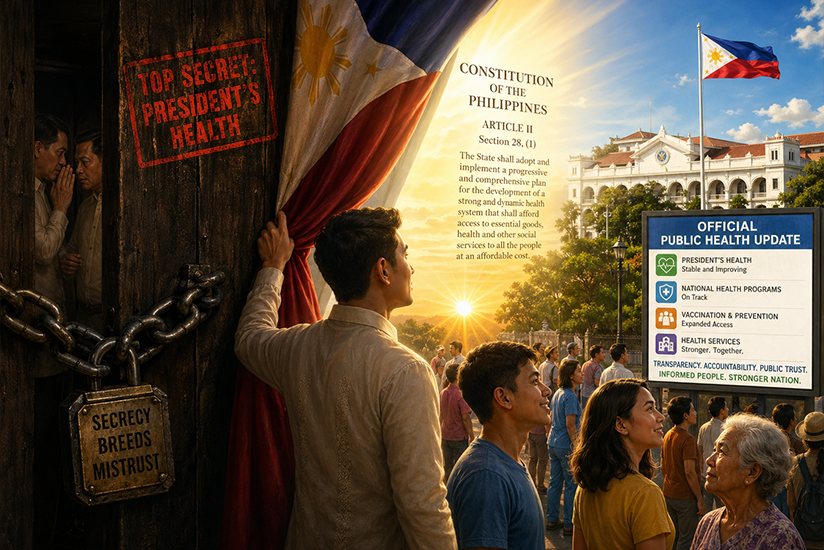
The 1987 Philippine Constitution enshrines transparency in governance. Article VII, Section 12 explicitly states: “In case of serious illness of the President, the public shall be informed of the state of his health.” This provision is not ornamental—it is a safeguard ensuring that the nation is never left in the dark about the capacity of its leader to govern. Coupled with Article III, Section 7, which guarantees the people’s right to information on matters of public concern, the Constitution affirms that the health of the President is not a private matter but a public trust.
Historical Precedents
The issue of presidential health disclosure has surfaced repeatedly in Philippine history:
* Ferdinand Marcos Sr. concealed his kidney disease for years, fueling political instability and speculation. Only in the mid-1980s was the truth acknowledged, by which time governance had already been compromised.
* Corazon Aquino openly shared her battle with colon cancer in 2008, allowing the nation to prepare emotionally and politically for her passing.
* Fidel Ramos disclosed his blocked carotid artery in 1996, undergoing surgery the same day, reassuring the public of continuity in leadership.
* Rodrigo Duterte faced petitions for disclosure regarding his health conditions. While the Supreme Court dismissed mandamus petitions, the controversy highlighted the tension between privacy and public accountability.
These precedents underscore a vital truth: secrecy breeds suspicion, while transparency strengthens trust.
Current Context
The Supreme Court’s directive for President Ferdinand Marcos Jr. to comment on a petition seeking a medical examination—including a hair follicle drug test—revives this constitutional debate. The petitioners argue that the people deserve clarity on the President’s physical and mental fitness to discharge the duties of the highest office. The Court’s involvement signals that this is not a trivial matter but one that touches the very core of democratic accountability.
The People’s Right to Know
The presidency is not a private enterprise; it is a public trust. The Filipino people, who vest sovereign power in their leader, have the right to assurance that their President is capable of fulfilling his constitutional duties. Transparency in health is not an intrusion into privacy—it is a safeguard of democracy. When leaders conceal their condition, they erode confidence and invite instability. When they disclose, they strengthen legitimacy and foster unity.
Conclusion
The Constitution demands disclosure in cases of serious illness. History warns us of the dangers of secrecy. The present moment calls for courage and clarity. For the sake of trust, stability, and democratic integrity, the President must submit to examination and disclose the results. Anything less is a betrayal of the covenant between leader and people.
In a democracy, the health of the President is the health of the Republic. The people’s right to know is not negotiable—it is constitutional, historical, and moral.
#RelentlessForChange









Leave a Reply