



he Health Facilities Enhancement Program (HFEP) was designed as a major therapeutic intervention for a health system long starved of infrastructure. Over the past decade, approximately PHP 400 billion has been infused to build hospitals, rural health units, and specialty facilities across the country. On paper, that sounds like aggressive, life-saving treatment.
Yet current data suggests the patient remains critically ill.
Only about one-third of newly funded health centers are fully operational, meaning many structures exist without staff, equipment, or integration into care networks. This is what clinicians would call systemic ischemia—resources are present, but they are not reaching the tissues that need them.
Several warning signs stand out. First, there is wasted volume: roughly PHP 183 million worth of medical equipment remains idle, either because buildings are unfinished or there is no trained manpower to operate them. Second, there is delayed flow: about PHP 2.83 billion in projects are stalled, leading to facilities deteriorating before they ever treat a single patient—what can only be described as infrastructure necrosis. Third, there is a persistent access gap, with nearly half of Filipinos still outside the 30-minute window for primary care, a critical benchmark for preventing complications and deaths.
The core pathology is not lack of funding. It is the disconnect between construction and health system readiness.
From a medical perspective, this is not a case for more of the same treatment. It calls for a change in protocol.
First, a “pre-operative clearance” must be mandatory. No HFEP funds should be released without proof of lot ownership, facility readiness, and a multi-year staffing plan approved by both local government and the Department of Health. Second, evaluation must shift from ribbon-cutting to functional audits. Success should be measured by patient consultations, service delivery, and local health outcomes—not merely by completed buildings. Third, HFEP facilities must be fully integrated into Provincial Health Systems, as mandated by the Universal Health Care law, to ensure proper referral pathways and continuity of care.
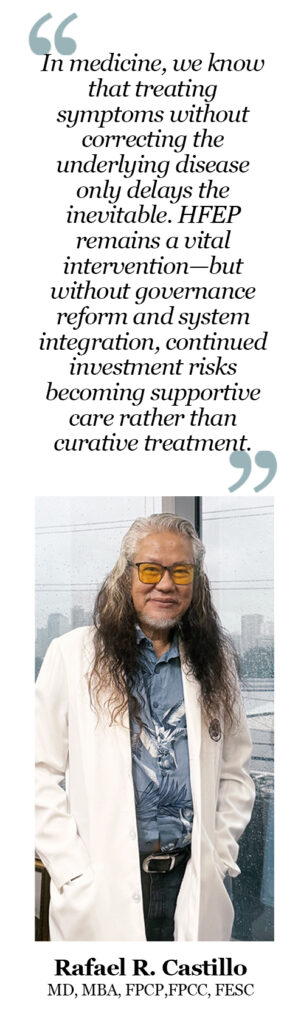
In medicine, we know that treating symptoms without correcting the underlying disease only delays the inevitable. HFEP remains a vital intervention—but without governance reform and system integration, continued investment risks becoming supportive care rather than curative treatment.
Infrastructure saves lives only when it is alive, staffed, and connected to the rest of the system.