

By Henrylito D. Tacio
“You may say I’m a dreamer, but I’m not the only one. I hope someday you’ll join us. And the world will live as one.” ― John Lennon
***
Hope is frequently regarded as a wellspring of resilience, enabling individuals to withstand difficulties and imagine possibilities that extend beyond their present challenges. Several concepts highlight that hope is not a passive state; rather, it fosters action, perseverance, and faith in favorable outcomes.
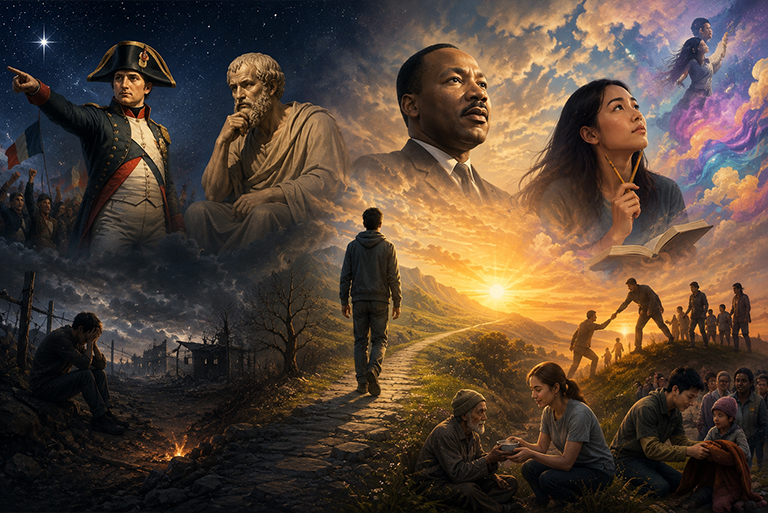
Napoleon Bonaparte, for instance, referred to a leader as “a dealer in hope,” underscoring its significance in motivating others. Likewise, Aristotle remarked that while patience may be bitter, its rewards are sweet, thereby linking hope with the benefits of persistence.
Hope springs eternal, so goes a saying. “Hope itself is like a star – not to be seen in the sunshine of prosperity, and only to be discovered in the night of adversity,” said English Baptist preacher Charles Haddon Spurgeon.
Martin Luther King, Jr. also stated, “If you lose hope, somehow you lose the vitality that keeps moving, you lose that courage to be, that quality that helps you go on in spite of it all. And so today I still have a dream.”
“We dream to give ourselves hope,” Amy Tan wrote in The Hundred Secret Senses. “To stop dreaming – well, that’s like saying you can never change your fate.”
Pittacus Lore, the story writer of I Am Number Four, reminded us: “When you have lost hope, you have lost everything. And when you think all is lost, when all is dire and bleak, there is always hope.”
American historian and playwright Howard Zinn penned: “To be hopeful in bad times is not just foolishly romantic. It is based on the fact that human history is a history not only of cruelty, but also of compassion, sacrifice, courage, kindness.”
He continued: “What we choose to emphasize in this complex history will determine our lives. If we see only the worst, it destroys our capacity to do something. If we remember those times and places—and there are so many—where people have behaved magnificently, this gives us the energy to act, and at least the possibility of sending this spinning top of a world in a different direction.
Zinn further said: “And if we do act, however small a way, we don’t have to wait for some grand utopian future. The future is an infinite succession of presents, and to live now as we think human beings should live, in defiance of all that is bad around us, is itself a marvelous victory.”
This reminds me of a story shared by Willi Hoffseummer in 1000 Stories You Can Use:
In one corner of the world squatted a sullen, sulking, chilly, friendless darkness. Suddenly, a tiny light appeared in a forsaken corner. It was small, but it was a light. Someone had put it there. It just stood there and radiated.
A passerby remarked, “Don’t you think you would be more useful somewhere else and not in this forsaken corner?”
“Why?” asked the little light. “I shine because I am a light. And because I shine, I am a light. I don’t shine in order to be seen. No. I shine because it gives me joy to shine, and to be a light.”
But when the gloomy darkness heard this, it gritted its teeth and full of fury tried to put the light out. But the gigantic darkness was powerless against this tiny light.
“When you think everything is hopeless, a little ray of light comes from somewhere,” said an inscription in an old inn in St. Moritz in Switzerland. Martin Luther King, Jr. himself said: “Only in the darkness can you see the stars.”
In Daughter of Smoke and Bone, Laini Taylor wrote: “Hope can be a powerful force. Maybe there’s no actual magic in it, but when you know what you hope for most and hold it like a light within you, you can make things happen, almost like magic.”
In times of troubles
Hope serves as a psychological anchor in times of uncertainty. It empowers us to continue progressing when the way forward is not clear. Consider uncertainty as akin to navigating through a dense, fog-laden forest. In the absence of hope, one might choose to sit down and surrender, unable to perceive the end of the path.
Hope functions like a powerful flashlight, illuminating the ground directly in front of you. While the ultimate destination remains unseen, you are aware that you can take the next step.
As Dr. Andrea Bonior wrote in Psychology Today: “One is that when we have hope, we are more likely to think of a specific pathway of how to move forward in the ways that will bring us a sense of agency: we feel less helpless and less uncertain about the future. Increased hope also gives us a buffer in order to sustain some setbacks: it can help with our resilience when there are bumps in the road, helping us have the energy to continue on the path that we are on before giving up.”
Hope improves mental health
Numerous studies link hope to reduced levels of anxiety and depression. This correlation is not surprising, as hopelessness can often manifest as a symptom of depression, suggesting a negative relationship between hope and depression.
“But it also may well be true that hope helps protect against depression in the first place,” Dr. Bonior pointed out. “By having a more optimistic outlook, you are better able to avoid the all-or-none thinking that keeps you in the mental rut of believing that when one thing goes wrong, everything goes wrong—or that things will never get better.”
Hope builds inner strength
Psychologists claim hope enhances cognitive function. According to them, hope stimulates the brain to produce neurotransmitters such as dopamine and serotonin. These substances reduce stress and provide motivation.
Consequently, hope aids in problem-solving, as hope functions similarly to a muscle; it conditions your brain to make decisions rather than becoming paralyzed in challenging situations.
Furthermore, hope establishes a clear pathway. It transcends mere wishful thinking; it embodies the capacity to set objectives and determine the precise actions required to achieve them.
A long, long time ago, in North China, there resided an elderly man. His home faced south, and directly in front of his door loomed the two massive peaks of Taihung and Wangwu, obstructing his path to the south. Thus, he gathered his sons, made a solemn vow, and then stepped out of his house. They resolved to hack away at those two mountains.
A neighbor observed their efforts and shook his head in disbelief. “How foolish can one be?” he exclaimed. “It is utterly impossible for you to remove these mighty mountains.”
The old man smiled and replied, “Well, when we pass away, my sons will take over the task. When they are gone, my grandsons will carry it on. Indeed, the mountains are tall, but they will not grow any taller. However, our strength can still increase. With every bit of earth we remove, we draw nearer to our objective. It is far better to act than to merely sit and lament that these mountains block the sunlight.”
With unwavering determination, the old man continued to dig. God observed this and was moved to send two of His messengers to earth. They lifted the two mountains onto their shoulders and carried them away.
Former American president Barack Obama once said: “The best way to not feel hopeless is to get up and do something. Don’t wait for good things to happen to you. If you go out and make some good things happen, you will fill the world with hope, you will fill yourself with hope.”








Leave a Reply